The Stock Market as a Driver of Sustainable Growth
Commentary

A stock exchange is a centralized market which facilitates the buying and selling of stocks and other financial assets among investors (individual and corporate). The prices of assets traded on the exchange fluctuate based on a number of factors including macroeconomic trends, company performance and investor sentiment. From a business perspective, a well-functioning stock market is an essential institution for mobilizing capital, supporting business expansion, encouraging innovation, and promoting sustainable economic development.
For a small, open economy like Trinidad and Tobago, where economic diversification remains a national priority, strengthening the domestic capital market could become one of the most effective tools for achieving long-term, sustainable growth.
The Stock Market and Economic Growth/Development
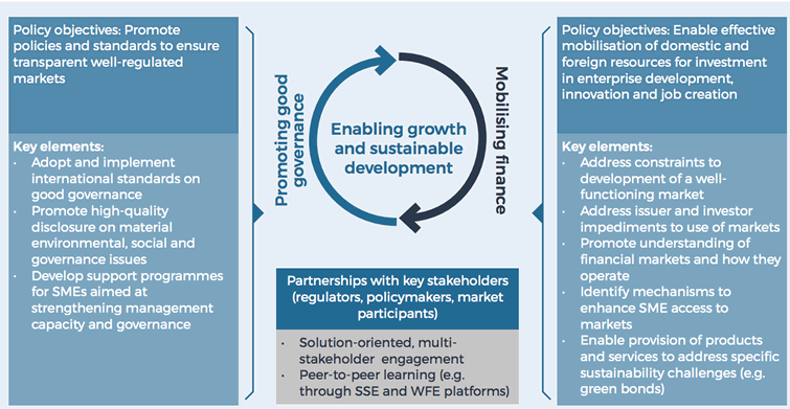
The relationship between stock markets and economic growth is somewhat ambiguous between advanced and developing economies, however, there are some key principles that are common between them. In a joint report by the United Nations Council on Trade and Development (UNCTAD) and the World Federation of Exchanges (WFE) titled “The Role of Stock Exchanges in Fostering Economic Growth and Sustainable Development”, two main mechanisms were highlighted by which functioning stock exchanges contribute to development:
- They assist with the mobilization of financial resources. This in turn drives sustainable development by improving access to finance for many companies. Small and medium-sized enterprises (SMEs) are noted to be a key focus of many exchanges around the world.
- They provide a platform to promote good governance and business practices. Many exchanges provide companies with guidance, listing rules, and training activities. On the SME side, programmes utilized by some exchanges are focused on developing management capacity, and strengthening governance structures, and improving innovation and growth capacity.
These mechanisms are summarized in the below chart:
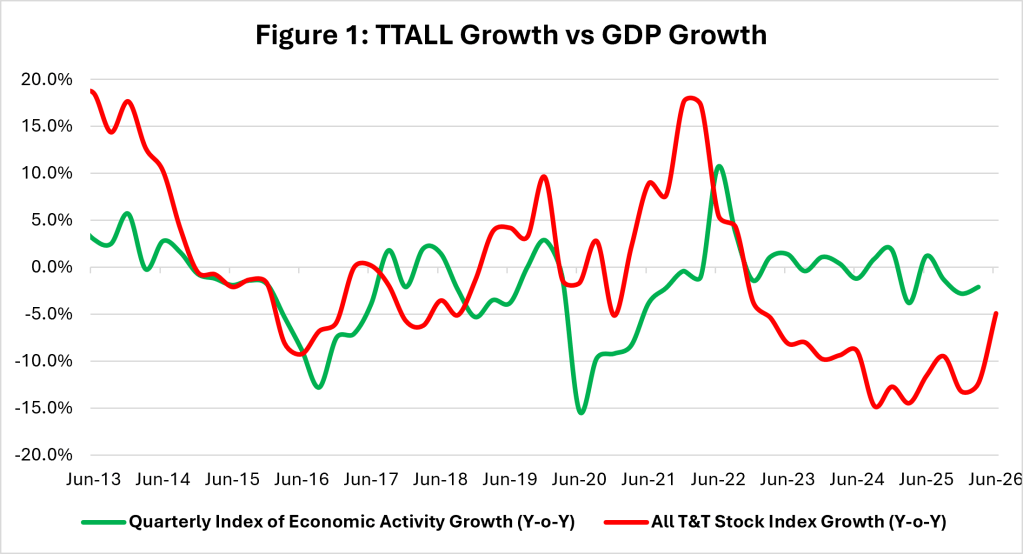
Importantly, the stock market also serves as a leading indicator of economic activity. Investor confidence often reflects expectations about future business conditions, consumer spending and economic performance. As confidence improves, investment generally follows, stimulating broader economic activity. Conversely, prolonged weakness in equity markets may signal concerns about current economic activity or growth prospects. Figure 1 shows the movements of the TTSE All T&T Stock Price Index (TTALL) and GDP Growth in Trinidad and Tobago and shows that the TTALL largely leads the direction of the economy.
Source: Central Bank of Trinidad and Tobago (CBTT), Trinidad and Tobago Stock Exchange (TTSE), First Citizens Economic Research
The ambiguity in the relationship between equity market growth and economic growth in developed economies arises from the mechanism by which the stock market promotes economic growth. The main point of contention is the impact of market liquidity on economic growth. Greater market liquidity, in this case meaning a sustainably high degree of daily trading activity on the exchanges, has a positive effect in promoting economic growth primarily for advanced economies. However, developing economies show mixed results as high market liquidity does not necessarily correlate with stronger economic growth contributed from the stock exchange.
Leveraging SMEs
A global trend that has gained traction in recent years is the inclusion of SMEs on their local stock exchanges. The WFE notes that in a survey of 72 member exchanges, 68% offer a specialized SME listing platform. The push has become more apparent in emerging and developing economies with the number of companies listed on member exchanges almost doubling between 2012 and 2022 to 2,148 listed SMEs. However, in Latin America and the Caribbean however, it was observed that the number of listed SMEs declined in the period.
For many SMEs, listing can appear daunting. Preparing audited financial statements, meeting governance requirements and navigating the listing process require both time and resources. From the investor’s perspective, liquidity remains another concern. Thin trading volumes can discourage participation because investors may find it difficult to buy or sell shares quickly without affecting prices.
In response to these challenges, stock exchanges around the world have responded by creating simplified listing regimes, mentorship programmes for SMEs, digital trading platforms and stronger investor education initiatives. In Trinidad and Tobago, the Trinidad and Tobago Stock Exchange (TTSE) has already taken steps in this direction by promoting the SME Market which was introduced in 2012. The TTSE offers several benefits to SMEs that wish to list on the junior exchange. In addition to facing less onerous listing requirements, companies can also access significant financial incentives including zero percent Corporation Tax, Green Fund and Business Levy for the first five (5) years from listing, with a 50% reduction on these taxes for the following five (5) years (i.e. years 6-10), as well as a number of non-financial benefits. Despite these benefits however, participation remains relatively limited, with only four actively listed companies at the time of writing.
Low Youth Participation
From an individual investor level, entering the stock exchange can be a very daunting task as a vast array of information is readily available and may overwhelm new investors. Added to this is a level of scepticism and mistrust that investors, particularly young investors have of the market. A 2016 survey by Bankrate, a financial services company, found that among the millennial generation in America, only 33% (one in three) are investing in the stock market. The issues highlighted for staying away from the market include a lack of disposable income, a lack of knowledge, risk aversion, and a lack of trust in the market/advisors.
Additionally, a 2022 study by Bank of America found that 75% of young investors in America (aged 21 – 42) thought it impossible to achieve above average returns in the traditional stock market. Instead, alternative investments such as real estate, peer-to-peer lending, and collectibles are being pursued.
T&T’s Economy and the Market
The T&T economy has struggled to find its footing for over a decade, with GDP contracting by an annualized average of 1.46% between 2015 and 2025, and the economy remains below pre-pandemic levels. On a similar note, the TTALL index has contracted by an average of 2.9% in the same period. However, encouragingly, the TTALL Index has generated a 5.8% return for the year 2026 to date (as at 14 July 2026). If the relationship shown in Figure 1 holds and the TTALL index is a reliable leading indicator of GDP growth, there is the possibility that positive economic news could be around the corner.
T&T’s economy faces several structural challenges; the continued decline in natural gas production has constrained export earnings and government revenue, while persistent foreign exchange shortages have increased operating costs for many businesses by delaying imports of raw materials and capital equipment. Although inflation has eased significantly from its post-pandemic peak, higher prices over recent years have reduced household purchasing power and placed additional pressure on business profitability. Additionally, the TT-US interest rate differential (the difference between T&T and US interest rates) since 2023 has possibly contributed to capital outflows as investors flocked towards higher-earning US assets.
Conclusion
As Trinidad and Tobago seeks to build a more diversified and resilient economy, the role of the stock market should not be viewed solely through the lens of daily price movements or annual returns. The stock market should be judged by how effectively it connects investors with businesses that have the potential to innovate, expand and create employment. While the domestic market continues to face structural challenges; a focus on building a system capable of supporting a more diversified, competitive and resilient economy should remain a key focus for policy makers as a stronger capital market may prove to be one of its most valuable assets.
DISCLAIMER
First Citizens Bank Limited (hereinafter “the Bank”) has prepared this report which is provided for informational purposes only and without any obligation, whether contractual or otherwise. The content of the report is subject to change without any prior notice. All opinions and estimates in the report constitute the author’s own judgment as at the date of the report. All information contained in the report that has been obtained or arrived at from sources which the Bank believes to be reliable in good faith but the Bank disclaims any warranty, express or implied, as to the accuracy, timeliness, completeness of the information given or the assessments made in the report and opinions expressed in the report may change without notice. The Bank disclaims any and all warranties, express or implied, including without limitation warranties of satisfactory quality and fitness for a particular purpose with respect to the information contained in the report. This report does not constitute nor is it intended as a solicitation, an offer, a recommendation to buy, hold, or sell any securities, products, service, investment, or a recommendation to participate in any particular trading scheme discussed herein. The securities discussed in this report may not be suitable to all investors, therefore Investors wishing to purchase any of the securities mentioned should consult an investment adviser. The information in this report is not intended, in part or in whole, as financial advice. The information in this report shall not be used as part of any prospectus, offering memorandum or other disclosure ascribable to any issuer of securities. The use of the information in this report for the purpose of or with the effect of incorporating any such information into any disclosure intended for any investor or potential investor is not authorized.
DISCLOSURE
We, First Citizens Bank Limited hereby state that (1) the views expressed in this Research report reflect our personal view about any or all of the subject securities or issuers referred to in this Research report, (2) we are a beneficial owner of securities of the issuer (3) no part of our compensation was, is or will be directly or indirectly related to the specific recommendations or views expressed in this Research report (4) we have acted as underwriter in the distribution of securities referred to in this Research report in the three years immediately preceding and (5) we do have a direct or indirect financial or other interest in the subject securities or issuers referred to in this Research report.