The Return of IPOs: What the Revival Means for Investors
Commentary

The Return of IPOs: A New Chapter for the Stock Market
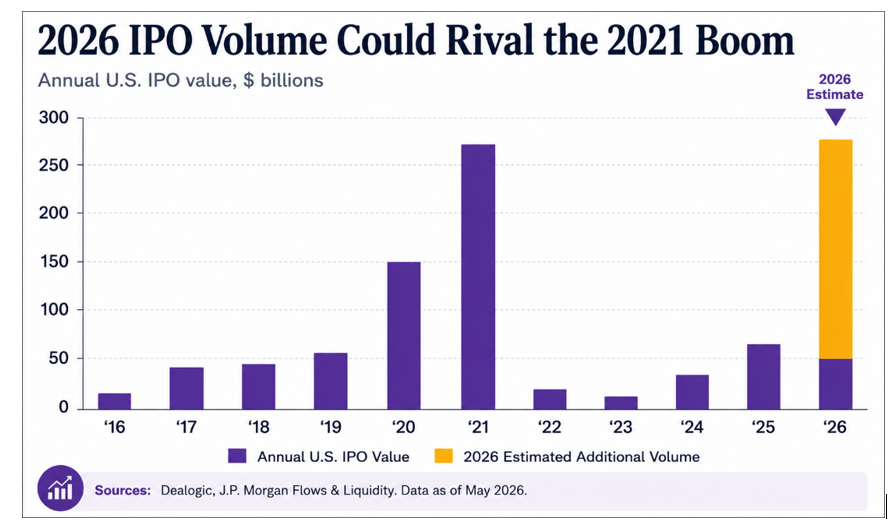
The Initial Public Offering (IPO) market is making a comeback. After nearly four years of subdued activity, companies that delayed going public during a period of high inflation, rising interest rates and economic uncertainty are finally returning to the stock market. Many analysts now expect 2026 to become one of the busiest years for IPOs since the record-breaking boom of 2021.
For a while, the market went unusually quiet. Then something began to change. Inflation started easing, businesses proved to be more resilient than many economists expected, and confidence slowly returned to financial markets. At the same time, a technological revolution centred around artificial intelligence (AI) sparked one of the biggest waves of corporate investment in decades. Suddenly, companies that had been sitting on the sidelines were looking at the stock market with fresh optimism.
Today, that patience appears to be paying off. Some of the world’s largest companies are once again entering the public markets. Following SpaceX’s landmark IPO in June 2026, attention has shifted to other high-profile private companies. Stripe, one of the world’s leading digital payments companies, and Databricks, a leading artificial intelligence (AI) and cloud data analytics platform, are among the firms widely linked to upcoming IPOs, while private companies such as Canva, the online design software company, and Discord, the popular communications platform, continue to fuel speculation about future listings. Together, these companies, alongside many smaller businesses, could sustain one of the strongest periods of IPO activity since the boom of 2021. For everyday investors, that raises an important question: How should you think about this new IPO wave, and what does it really mean for your portfolio?
What Is an IPO and Why Should You Care?
An Initial Public Offering, or IPO, is the first time a private company offers shares of ownership to the general public through a stock exchange. When people buy those shares, they become part owners of the business. If the company grows and becomes more valuable, the price of those shares may rise, allowing investors to earn a return. Of course, the opposite can happen too. If the business struggles, the share price may fall. For companies, an IPO is about much more than simply raising money.
Going public can increase a company’s visibility, strengthen its reputation, make it easier to attract talented employees through share-based compensation and provide existing owners with an opportunity to sell part of their investment.
For investors, meanwhile, IPOs offer the chance to invest in businesses that were previously unavailable to the public. Some of today’s largest companies, including Amazon, Google and Meta, were once IPOs themselves. Of course, not every newly listed company becomes the next industry leader. Some exceed expectations, while others struggle to justify the excitement surrounding their debut. That is why understanding the broader market environment is just as important as understanding the individual company. And right now, that environment looks very different from what it did just a few years ago.
For investors in Trinidad and Tobago, IPOs matter for another reason. While much of the recent excitement has centred on large U.S. listings, our own capital market has also shown encouraging signs of renewed activity.
Figure 1: 2026 IPO Volume Could Rival the 2021 Boom
(Source: J.P. Morgan Private Bank; Dealogic; J.P. Morgan Flows & Liquidity. Data as of May 2026.)
Over the past two years, the Trinidad and Tobago Stock Exchange has welcomed several new listings, including Eric Solis Marketing Limited (2024), Medcorp Limited (2025), A.S. Bryden & Sons Holdings Limited (2025) and, more recently, West Indian Traders Limited (2026).
Each new listing gives local investors another opportunity to participate in the growth of established businesses while helping to deepen the domestic capital market. A broader pipeline of IPOs can also improve market liquidity, increase sector diversification and provide companies with an alternative source of financing beyond traditional bank lending, benefits that ultimately support long-term economic growth.
Why Companies Are Returning to the Stock Market
To understand why IPO activity is gaining momentum again, it helps to look back just a few years. During 2022 and much of 2023, central banks around the world raised interest rates sharply to fight inflation. Higher interest rates increase the cost of borrowing, making it more expensive for businesses to expand and for consumers to spend. At the same time, investors became more cautious, choosing safer investments over riskier growth companies. Faced with this uncertainty, many businesses delayed their plans to go public, deciding to wait for more favourable market conditions.
Today, the outlook has improved considerably. Inflation has moderated in many major economies, businesses have continued to report solid earnings, unemployment has remained relatively low and consumer spending has proven more resilient than expected. As confidence has gradually returned, investors have become more willing to support growing companies, creating a more favourable environment for IPOs. However, improving economic conditions are only part of the story. A powerful new force is also reshaping the investment landscape, artificial intelligence (AI).
The AI Revolution Is Fuelling More Than Just Technology
While most people associate artificial intelligence (AI) with tools like ChatGPT or image generators, the technology is driving far more than smarter software. Behind every AI application is an enormous amount of infrastructure that must be built, from advanced computer chips and massive data centres to electricity networks, fibre-optic cables and cooling systems. Think of it like building a brand-new city: before anyone can move in, roads, utilities and buildings must first be constructed. The AI economy works in much the same way.
As companies race to develop and deploy AI, they are investing hundreds of billions of dollars in the infrastructure needed to support it. This investment is creating opportunities not only for technology companies, but also for manufacturers, construction firms, utilities, engineering companies, logistics providers, semiconductor equipment manufacturers, industrial automation businesses and cybersecurity firms. In other words, AI is fuelling investment across much of the global economy rather than remaining confined to the technology sector.
This surge in investment is doing more than driving economic activity, it is also increasing the demand for capital. Many companies need significant funding to expand production, build new facilities, invest in research and development, or acquire new technologies. While some businesses can raise capital through private investors or borrowing, others view an initial public offering (IPO) as an attractive way to finance their next stage of growth. At the same time, improving economic conditions and stronger investor confidence have created a more supportive environment for companies considering a public listing. As more companies prepare to go public, however, another question naturally arises: Can investors absorb all these new shares, or will they need to sell existing investments to make room? The answer lies in something many people overlook, just how much today’s stock market has grown.
Can Today’s Market Really Absorb a New IPO Wave?
As more companies prepare to go public, it’s natural to wonder whether investors will have enough money to buy all these new shares. At first glance, it might seem that every dollar invested in a new IPO has to come from selling another stock. While that does happen to some extent, it overlooks how much the market has changed over the past decade. Today’s stock market is significantly larger than it was during previous IPO booms. The combined value of publicly listed companies has grown into the tens of trillions of dollars, supported by stronger corporate earnings, technological innovation and a much broader investor base. As a result, even several large IPOs represent only a small fraction of the overall market. In simple terms, the market has grown so much that it is better equipped to absorb new companies than it was years ago.
Liquidity: The Market’s Ability to Keep Money Moving
Another key support is liquidity, the ease with which shares can be bought and sold without causing big price swings. Every day, billions of dollars of stock change hands as pension funds, mutual funds, insurance companies, exchange‑traded funds (ETFs) and individual investors trade. With so many participants active in the market, large transactions are generally absorbed more smoothly than in the past. That doesn’t eliminate volatility, but it helps reduce the risk that a few big IPOs alone will disrupt the entire market.
The Hidden Force Supporting the Market: Share Buybacks
While IPOs introduce new shares into the market, many existing companies are doing the opposite. Through share buybacks, companies repurchase their own shares, reducing the number available for investors to trade. Although share buybacks do not directly finance IPOs or occur simultaneously with new listings, they reduce the overall supply of publicly traded shares over time. As a result, they help offset some of the additional equity entering the market, providing another source of support for overall market liquidity. In recent years, buybacks have reached record levels globally, with estimates in some periods exceeding USD 1.5 trillion in annual repurchases.
Figure 2: Net Household Demand for U.S Corporate Equities
Source: J.P. Morgan Private Bank, based on Federal Reserve data. Data as of September 30, 2025.
Passive Investing Is Another Source of Demand
Another important trend has been the rapid growth of index funds and exchange-traded funds (ETFs). Rather than selecting individual stocks, these funds automatically invest in companies that make up major market indexes, such as the S&P 500. As more people invest for retirement and long‑term goals using these vehicles, a steady stream of money flows into the market. That ongoing demand supports share prices over time and provides another cushion as new companies come to market.

Everyday Investors Are More Involved Than Before
Individual investors are also contributing more than ever before. The rise of low-cost investment platforms and commission-free trading has made investing accessible to millions of people who previously had little involvement in the stock market. Many of these investors contribute regularly through retirement plans or long-term investment accounts, providing another consistent source of capital. Taken together, these factors, a larger market, stronger liquidity, record share buybacks, growing passive investing and increased participation from everyday investors, suggest that today’s market is better positioned to absorb a new wave of IPOs than it was during previous cycles. Of course, this doesn’t mean every IPO will be successful or that markets are free from risk. Like any investment, newly listed companies will still face economic uncertainty, changing investor sentiment and the challenge of delivering on investors’ expectations.
The Risks You Still Need to Keep in Mind
The outlook for IPOs appears increasingly encouraging. Economic conditions have improved, businesses are investing again, artificial intelligence (AI) is driving innovation, and today’s stock market is larger and more liquid than during previous IPO cycles. Combined with record corporate share buybacks and continued inflows into retirement funds, index funds and retail investment accounts, many analysts believe the market is well positioned to absorb a new wave of public listings.
However, no investment story is without risk. Interest rates remain a key uncertainty. While inflation has eased, any renewed price pressures could keep borrowing costs elevated, reducing both corporate investment and investors’ willingness to take on risk. Geopolitical tensions, trade disputes and a sharper-than-expected economic slowdown could also delay IPO activity if market conditions deteriorate.
It is equally important to recognise that not every IPO becomes a long-term success. Going public marks the beginning, not the end, of a company’s growth journey. Newly listed companies must consistently deliver financial results, compete in evolving industries and justify their valuations. For this reason, investors should focus on business fundamentals, including profitability, competitive advantages, growth prospects and valuation, rather than the excitement surrounding a new listing.
For most investors, the revival in IPO activity should be viewed as a sign of improving market confidence rather than a reason to chase every new offering. A diversified portfolio and a long-term investment approach remain the most reliable strategies for building wealth.
For investors in Trinidad and Tobago and the wider Caribbean, renewed global IPO activity may also create indirect opportunities through internationally diversified mutual funds, exchange-traded funds (ETFs) and cross-listed securities. As successful IPOs are added to major market indices, their performance may gradually be reflected in the portfolios of regional investors.
Ultimately, the return of IPOs represents more than the success or failure of individual companies. It signals renewed business confidence, stronger capital markets and a willingness to invest in future growth. While uncertainty will always be part of investing, today’s deeper and more liquid markets appear better positioned to support a new generation of public companies. Whether every IPO succeeds is impossible to predict, but the willingness of businesses to enter the public markets remains one of the clearest indicators of confidence in the broader economy.
DISCLAIMER
First Citizens Bank Limited (hereinafter “the Bank”) has prepared this report which is provided for informational purposes only and without any obligation, whether contractual or otherwise. The content of the report is subject to change without any prior notice. All opinions and estimates in the report constitute the author’s own judgment as at the date of the report. All information contained in the report that has been obtained or arrived at from sources which the Bank believes to be reliable in good faith but the Bank disclaims any warranty, express or implied, as to the accuracy, timeliness, completeness of the information given or the assessments made in the report and opinions expressed in the report may change without notice. The Bank disclaims any and all warranties, express or implied, including without limitation warranties of satisfactory quality and fitness for a particular purpose with respect to the information contained in the report. This report does not constitute nor is it intended as a solicitation, an offer, a recommendation to buy, hold, or sell any securities, products, service, investment, or a recommendation to participate in any particular trading scheme discussed herein. The securities discussed in this report may not be suitable to all investors, therefore Investors wishing to purchase any of the securities mentioned should consult an investment adviser. The information in this report is not intended, in part or in whole, as financial advice. The information in this report shall not be used as part of any prospectus, offering memorandum or other disclosure ascribable to any issuer of securities. The use of the information in this report for the purpose of or with the effect of incorporating any such information into any disclosure intended for any investor or potential investor is not authorized.
DISCLOSURE
We, First Citizens Bank Limited hereby state that (1) the views expressed in this Research report reflect our personal view about any or all of the subject securities or issuers referred to in this Research report, (2) we are a beneficial owner of securities of the issuer (3) no part of our compensation was, is or will be directly or indirectly related to the specific recommendations or views expressed in this Research report (4) we have acted as underwriter in the distribution of securities referred to in this Research report in the three years immediately preceding and (5) we do have a direct or indirect financial or other interest in the subject securities or issuers referred to in this Research report.