The Fiscal Challenge Facing St. Vincent and the Grenadines
Commentary
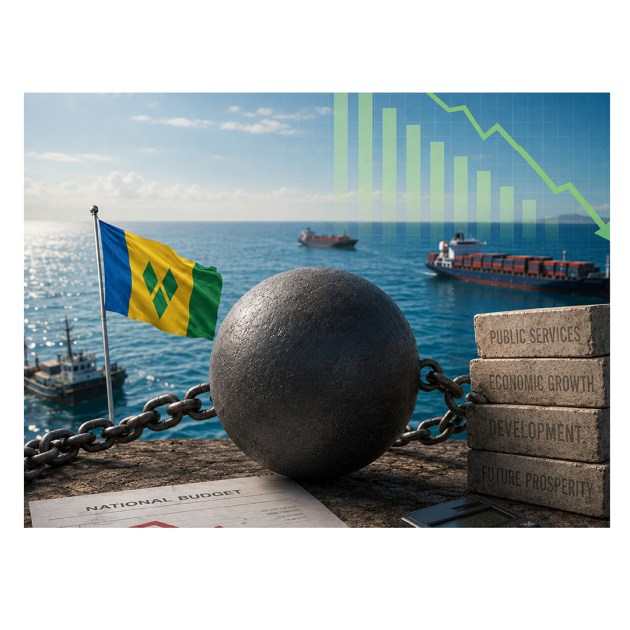
The Fiscal Challenge Facing St. Vincent and the Grenadines. Imagine you are living in St. Vincent and the Grenadines (SVG). In April 2021, the eruption of La Soufriere forces you from your home. Roads are damaged, businesses close, farms are buried beneath volcanic ash, and communities begin the long process of rebuilding. Just as life starts to return to normal, Hurricane Beryl strikes in July 2024, causing widespread destruction once again. Before the country has fully recovered from one disaster, it is confronted by another.
Now imagine trying to rebuild your finances each time this happens. Savings disappear, insurance covers only part of the damage, and borrowing becomes less of a choice than a necessity. While households may rely on loans to rebuild their homes, governments often face the same reality on a much larger scale, borrowing to restore roads, hospitals, ports, utilities and other critical infrastructure that cannot simply be left in ruins. What happens when a country spends years rebuilding faster than it can financially recover?
When Vulnerability Meets Fiscal Reality
For many Small Island Developing States (SIDS), this is no longer a hypothetical scenario. For decades, governments have been judged by familiar fiscal indicators such as debt-to-GDP ratios, fiscal deficits, and primary balances. Rising debt is often interpreted as evidence of fiscal deterioration, raising concerns over debt sustainability, investor confidence and macroeconomic stability.
But what if rising debt is not simply the result of excessive government spending? For highly vulnerable economies, it increasingly reflects the unavoidable cost of rebuilding, adapting and surviving. These questions lie at the center of the fiscal challenge facing SVG. Successive natural disasters have undoubtedly contributed to rising public borrowing, but vulnerability cannot become a permanent justification for debt accumulation. In fact, the opposite is true. The more exposed an economy is to future shocks the greater the need to preserve fiscal space and build financial buffers before the next disaster strikes. The challenge for policymakers is therefore not simply whether to borrow, but how to balance the immediate necessity of reconstruction with the long-term objective of maintaining debt sustainability.
Growth Does not Always Improve Debt Dynamics
Conventional macroeconomics suggests that sustained economic growth should gradually improve debt sustainability. As national income expands, government revenues typically increase, fiscal deficits narrow, and the debt-to-GDP ratio stabilises or declines, provided borrowing remains contained. Yet SVG presents an important deviation from this conventional narrative.
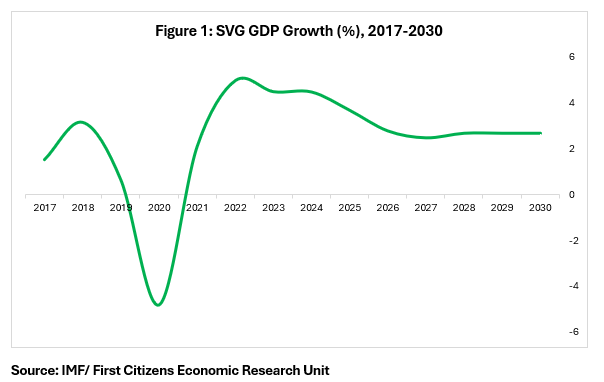
According to the International Monetary Fund (IMF), real GDP expanded by 4.5% in 2024, before moderation to 3.7% in 2025, remaining among the stronger-performing economies within the Eastern Caribbean Currency Union (ECCU). Growth is projected to moderate further to 2.8% in 2026 before converging to approximately 2.7% over the medium term (Figure 1).
Under normal circumstances, this pace of expansion would somewhat be expected to improve public debt dynamics. Instead, total public sector debt climbed to 113.1% of GDP (XCD3.6 billion) at the end of 2025, an increase of approximately 45% of GDP since 2019, with almost half of this increase occurring over the past two years alone. Under the IMF’s baseline scenario, debt is projected to rise further to 120.1% of GDP in 2026 before reaching 144.5% of GDP by 2031. (Figure 2)
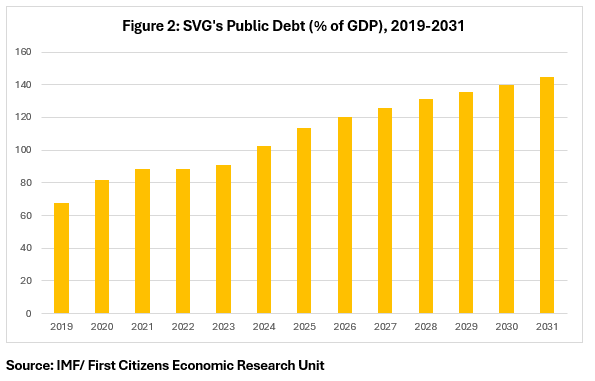
At first glance, the solution appears straightforward: grow the economy. Yet the IMF’s projections suggest otherwise. Despite positive GDP growth throughout the forecast horizon, public debt continues to rise. So, is the problem insufficient growth, or has the pace of borrowing begun to outstrip the economy’s capacity to generate the revenues needed to stabilize debt?
The IMF’s latest Debt Sustainability Analysis provides some preliminary answers to this question. For the first time in recent years, the Fund revised its assessment of SVG’s public debt from sustainable to unsustainable, reflecting the cumulative impact of successive external shocks, widening fiscal deficits, and elevated reconstruction-related borrowing. While the COVID-19 pandemic, the eruption of the La Soufriere, Hurricane Beryl and the recent oil price shock each placed considerable pressure on the public finances, the concern is no longer simply the increase in debt itself, but the absence of a stabilising trend.
The composition of debt further illustrates the scale of government’s financing requirements. At the end of 2025, central government debt accounted for 111.0% of GDP, while guaranteed state-owned enterprise liabilities contributed to an additional 2.0% of GDP. Domestically, commercial banks remain the government’s principal creditors, while externally, borrowing is concentrated among multilateral and bilateral institutions such as the World Bank and the Caribbean Development Bank (CDB). This creditor profile has provided access to concessional financing following repeated disasters, but it also highlights the country’s increasing dependence on external support to sustain reconstruction and development spending. While concessional financing has enabled SVG to respond to successive shocks at relatively favourable borrowing terms, it cannot replace the need for gradual fiscal adjustment. Without improvements in the underlying fiscal position, even low-cost borrowing contributes to rising debt over time.
Why Fiscal Deficits Become Persistent
The IMF projects SVG’s fiscal deficit at 12.4% of GDP in 2026, alongside a primary deficit of 8.2% of GDP (Figure 3), reflecting continued reconstruction spending, infrastructure investment and other fiscal pressures. While the authorities are preparing a medium-term fiscal consolidation strategy, no specific policy measures had been identified at the time of the assessment and were therefore not incorporated into the Fund’s baseline projections.
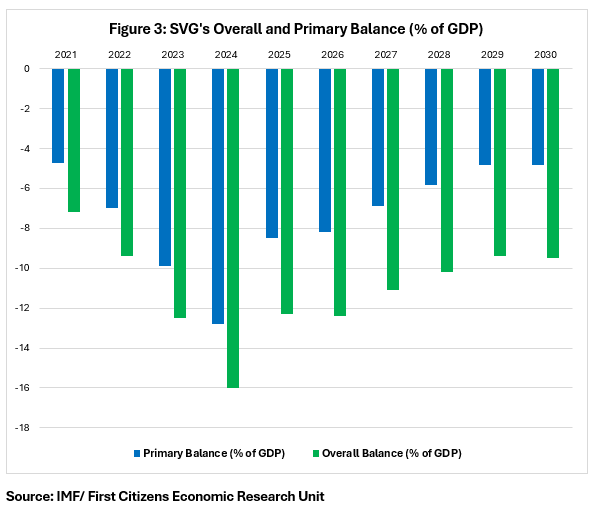
Economic growth undoubtedly strengthens government revenues, but when fiscal deficits remain persistently elevated, governments must continue financing expenditure through additional borrowing. Consequently, debt continues to accumulate despite positive economic growth, while rising interest obligations gradually consume a larger share of public resources that could otherwise be directed towards productive investment or strengthening resilience.
In other words, growth alone cannot offset persistent fiscal imbalances. Unless borrowing requirements gradually decline, stronger economic performance may slow the pace of debt accumulation but will not reverse its direction.
Fiscal Space Matters Most
The deterioration in SVG’s debt position extends beyond the size of the debt stock itself. More fundamentally, it reflects the gradual erosion of fiscal space, i.e. the government’s capacity to respond to future shocks without jeopardising macroeconomic stability or losing access to affordable financing.
For highly climate-vulnerable economies, fiscal space should be viewed as an integral component of resilience. Every major shock requires governments to mobilize resources rapidly, often before insurance payouts or external financing become available. Countries that enter these crises with stronger fiscal buffers are therefore better positioned to respond without significantly worsening their debt dynamics.
Paradoxically, this means that countries most vulnerable to natural disasters are also those that have the greatest need to preserve fiscal space. Vulnerability may explain why borrowing has increased in recent years, but it also strengthens, not weakens, the case for rebuilding financial buffers during periods of economic expansion.
Borrowing is necessary, but it must also be sustainable
One of the more difficult policy questions arising from SVG’s experience is whether climate vulnerability can justify persistently high levels of public debt.
There is little doubt that successive natural disasters have necessitated substantial public borrowing. Rebuilding homes, hospitals, schools, roads and other critical infrastructure cannot simply be postponed until fiscal conditions improve. In this context, borrowing has been an essential policy response rather than a discretionary choice.
For highly vulnerable economies, preserving fiscal space is itself a form of resilience. Every additional dollar borrowed today reduces the government’s capacity to respond to the next hurricane, volcanic eruption or external shock. Consequently, the objective is not simply to borrow less, but to ensure that borrowing supports investments that strengthen long-term resilience, raise productive capacity and ultimately reduce future reconstruction costs.
Against this backdrop, broadening the government’s financing options without increasing debt should also remain a policy priority. One option currently under consideration is the introduction of a Citizenship-by-Investment (CBI) programme. While such a programme could provide an additional source of non-debt fiscal revenue, its success would depend heavily on robust governance, transparency and due diligence, particularly given the significant reputational and financial integrity risks associated with CBI programmes. Consequently, any proceeds should be viewed as complementary to, not a substitute for, credible fiscal consolidation and, where implemented, prioritised towards debt reduction and rebuilding fiscal buffers.
Recognising this balance, the IMF argues that restoring debt sustainability will require a combination of front-loaded fiscal consolidation, stronger public debt management, growth-enhancing structural reforms and continued concessional financing from multilateral and bilateral development partners.
Conclusion
Economists often describe debt as borrowing from the future to finance the present. Yet, much like a household that repeatedly relies on loans to recover from unexpected emergencies, governments must eventually rebuild their financial capacity if they are to withstand future shocks. SVG’s debt story is therefore not simply one of rising debt ratios, nor solely one of repeated disasters. It is a story about balancing the immediate necessity of rebuilding with the equally important responsibility of preserving fiscal sustainability.
For vulnerable economies, fiscal space and financial buffers go beyond their traditional role as indicators of sound economic management, as they are essential resources that determine how effectively governments can respond when the next crisis inevitably arrives.
DISCLAIMER
First Citizens Bank Limited (hereinafter “the Bank”) has prepared this report which is provided for informational purposes only and without any obligation, whether contractual or otherwise. The content of the report is subject to change without any prior notice. All opinions and estimates in the report constitute the author’s own judgment as at the date of the report. All information contained in the report that has been obtained or arrived at from sources which the Bank believes to be reliable in good faith but the Bank disclaims any warranty, express or implied, as to the accuracy, timeliness, completeness of the information given or the assessments made in the report and opinions expressed in the report may change without notice. The Bank disclaims any and all warranties, express or implied, including without limitation warranties of satisfactory quality and fitness for a particular purpose with respect to the information contained in the report. This report does not constitute nor is it intended as a solicitation, an offer, a recommendation to buy, hold, or sell any securities, products, service, investment or a recommendation to participate in any particular trading scheme discussed herein. The securities discussed in this report may not be suitable to all investors, therefore Investors wishing to purchase any of the securities mentioned should consult an investment adviser. The information in this report is not intended, in part or in whole, as financial advice. The information in this report shall not be used as part of any prospectus, offering memorandum or other disclosure ascribable to any issuer of securities. The use of the information in this report for the purpose of or with the effect of incorporating any such information into any disclosure intended for any investor or potential investor is not authorized.
DISCLOSURE
We, First Citizens Bank Limited hereby state that (1) the views expressed in this Research report reflect our personal view about any or all of the subject securities or issuers referred to in this Research report, (2) we are a beneficial owner of securities of the issuer (3) no part of our compensation was, is or will be directly or indirectly related to the specific recommendations or views expressed in this Research report (4) we have acted as underwriter in the distribution of securities referred to in this Research report in the three years immediately preceding and (5) we do have a direct or indirect financial or other interest in the subject securities or issuers referred to in this Research report.