What Goes into Trinidad and Tobago’s Sovereign Credit Rating?
Commentary

When a government borrows money, investors must decide how likely they are to be repaid. Sovereign credit ratings help answer that important question, and they are evaluated by specialised rating agencies. Credit rating assessments condense a wide range of economic, financial and institutional information into a relatively simple grading system. Although they are primarily intended for investors, sovereign ratings can have broader consequences: they may influence how much a government pays to borrow, the range of investors willing to lend to the government and, indirectly, the financing conditions faced by domestic companies.
Trinidad and Tobago’s (T&T) sovereign rating history is illustrative of the country’s economic, fiscal and institutional developments impact on its perceived creditworthiness. The country’s credit profile has weakened over the past decade or more, falling from a previously enviable position supported by growth in the energy sector, strong government finances and substantial foreign-currency earnings. Nevertheless, sizeable financial buffers and a strong external position have helped T&T retain an investment-grade rating from one major agency.
What are Sovereign Ratings?
A sovereign credit rating is a forward-looking score that summarises a government’s ability and willingness to repay its debt in full and on time. Although a country’s rating is strongly correlated with measures of economic success such as GDP per capita, it is not a direct measure of how wealthy or well-governed a country is in every respect. Instead, it addresses the narrower question of creditworthiness, namely how much risk an investor assumes by lending to a particular country’s government.
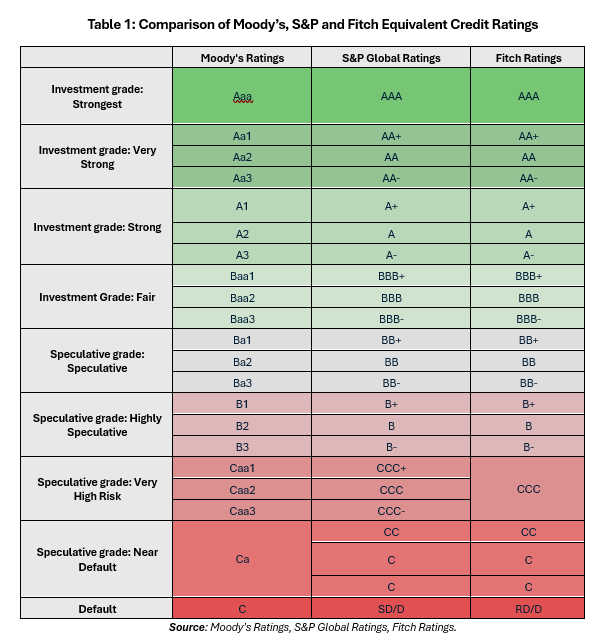
The best-known international rating agencies are Standard & Poor’s Global Ratings (S&P), Moody’s Ratings and Fitch Ratings. S&P and Fitch use a scale running from AAA, representing the strongest credit quality, to D, representing default. Moody’s uses a similar scale beginning at Aaa and ending at C. Under the S&P scale, BBB− is the lowest “investment-grade” rating, while BB+ and below are classified as “speculative grade” (alternatively, “junk”). The equivalent dividing line for Moody’s is Baa3 (the lowest investment-grade rating), followed by Ba1 (the highest speculative rating). Modifiers such as “+” and “−”, or Moody’s numerical suffixes 1, 2 and 3, provide additional distinctions within each category. Table 1 provides the comparison of equivalent credit ratings from each of the major rating agencies.
The sovereign rating, given by the rating scores discussed above, should also be distinguished from the outlook assigned to a particular sovereign rating. The outlook references the rating agency’s perspective on the evolution of the country’s rating over a particular time period, ranging from six months to two years. A positive outlook indicates that an upgrade has become more likely, while a negative outlook signals an elevated risk of a downgrade. A stable outlook means that the rating is unlikely to change over the agency’s usual assessment horizon. A change in a country’s outlook can therefore be either an important warning or favourable signal, but it is not itself a change in the country’s rating. The rating agencies combine quantitative measures with qualitative judgement. Their analysis generally covers economic growth and diversification; government revenue, expenditure and debt; foreign-exchange reserves and external debt; monetary flexibility; political institutions; policy effectiveness; and exposure to external shocks.
Ratings matter because investors normally demand higher interest rates from borrowers that are considered riskier. Some pension funds, insurance companies and investment funds also face restrictions on holding speculative-grade debt, therefore issuers on the borderline between investment grade and speculative, such as T&T, bear significant risk from the prospect of a downgrade. Losing investment-grade status can therefore reduce the pool of eligible investors and raise borrowing costs, increasing fiscal strain on economies and governments that are already under significant pressure. Sovereign ratings may also affect state enterprises and domestic banks because the government’s credit profile often acts as a benchmark (or ceiling) for other borrowing entities based in the country.
Trinidad and Tobago’s Rating History
T&T is rated by S&P and Moody’s only. The S&P rating is currently at BBB- with a negative outlook while Moody’s maintains a Ba2 rating with a stable outlook on T&T. T&T’s rating history can broadly be divided into two periods: the strong energy-driven years before the mid-2010s and the subsequent period of downgrades, stagnation and partial stabilisation. Figure 1 illustrates T&T’s rating history with S&P and charts the positive trajectory from 1996 (the first year that T&T was rated by S&P) to the country’s highest rating of A in 2008, followed by the decline that began in 2016, taking us to the present point where the rating stands at BBB-, the lowest investment grade level.
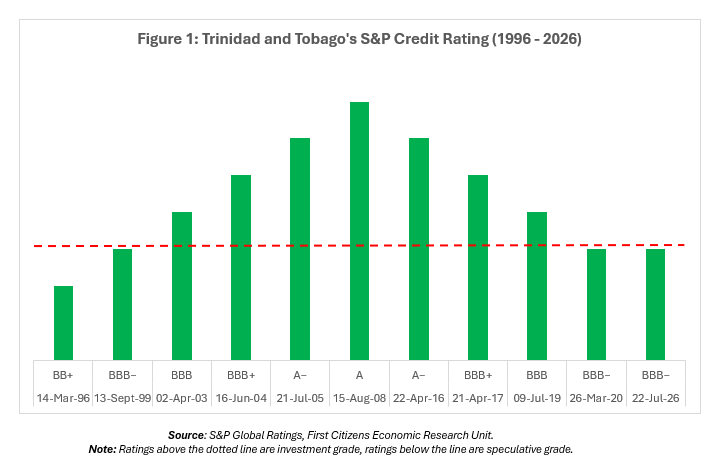
The country entered the 2010s with comparatively strong ratings. S&P upgraded T&T from A− to A in 2008 and maintained that rating, with a stable outlook, for several years. Moody’s rated the country Baa1 between 2011 and 2014, three notches above the bottom of its investment-grade range. These ratings reflected the benefits of the preceding energy boom: high national income, strong export earnings, relatively low government debt and the accumulation of savings in the Heritage and Stabilisation Fund (HSF). T&T’s established democratic institutions, developed financial system and external creditor position also provided important support.
The turning point in our rating history came with the collapse in international energy prices beginning in the second half of 2014. Lower oil and gas prices sharply reduced government revenue and export earnings, while declining production from mature fields constrained the economy’s ability to recover through higher output. In 2015, Moody’s lowered the sovereign rating from Baa1 to Baa2 and assigned a negative outlook. S&P retained its A rating during 2015 but also changed its outlook to negative.
The downward movement accelerated in 2016. Moody’s cut the rating again, from Baa2 to Baa3, while S&P lowered its rating from A to A−. The government increasingly depended on asset sales, special dividends and other one-off measures to finance expenditure, while the economy contracted and debt began to rise. In 2017, Moody’s reduced T&T’s rating from Baa3 to Ba1. This was an especially significant downgrade because it moved the country into Moody’s speculative grade territory. The agency cited an insufficient policy response to the energy shock, persistent fiscal deficits, increasing government debt and weak medium-term growth prospects for the downgrade at that time. S&P also downgraded the country’s credit rating in 2017, from A− to BBB+.
S&P subsequently lowered its rating to BBB in 2019 and then to BBB− in 2020. This placed T&T at the final rung of S&P’s investment-grade category. The COVID-19 pandemic compounded the country’s existing difficulties by reducing economic activity and government revenue while requiring additional public expenditure. In 2021, Moody’s lowered the rating once again, from Ba1 to Ba2, similarly highlighting pandemic-related debt increases, several years of economic contraction, limited diversification and longer-term risks associated with the global transition away from hydrocarbons.
Since 2021, neither agency has changed its rating on T&T. However, there have been several adjustments, both positive and negative, in the outlooks on the sovereign credit rating, which have mostly been driven by external factors such as geopolitics and energy prices. These external factors tend to have an outsized influence on the government’s near-term revenue situation.
In June 2026, Moody’s restored its outlook on T&T to stable from negative while affirming the Ba2 rating, citing improved near-term oil and gas price assumptions and a more favourable external debt-maturity profile. Moody’s also expects energy projects such as Manatee, Ginger and Aphrodite to lift natural-gas production from late 2027. However, it continues to view mature energy production, weak long-term growth, a high debt-to-GDP ratio and structural foreign-exchange pressures as important constraints. S&P’s July 2026 review highlighted similar constraints as it retained a negative outlook, indicating at least a one-in-three possibility of a downgrade over the following year. S&P expects the economy to contract in 2026 before new gas production supports growth in 2027 and projects a general government deficit of 4.4% of GDP for FY’2026. In S&P’s view, T&T’s continued investment-grade status is bolstered by strong current account surpluses and the presence of the HSF.
At present, therefore, S&P rates T&T at BBB− with a negative outlook, while Moody’s assigns Ba2 with a stable outlook. Moody’s rating is two notches below its investment-grade threshold, whereas S&P’s is precisely on the threshold. Examining the various rationales for the agencies’ decisions over the years, it is clear that while they may consider broadly similar evidence in their analysis, they can assign different weights to a country’s strengths, vulnerabilities and policy responses to economic circumstances, in determining ratings and outlooks.
Conclusion
A sovereign credit rating is one of the key metrics considered before investing in a country’s fixed-income instruments. T&T’s rating history tells the story of an economy adjusting to the end of an energy boom, and challenges to adapt fiscal and debt profiles to suit the new reality. The past 30 years also illustrate the factors that the rating agencies view as critical to a country’s ratings: internal and external drivers of economic growth; political stability; external buffers; fiscal discipline; monetary and exchange rate policy, among others. In the case of T&T, future rating improvements will depend not only on the arrival of new gas production, but also on whether the country can convert that temporary relief into sustained fiscal reform, broad-based economic growth and the sustainable rebuilding of financial buffers.
DISCLAIMER
First Citizens Bank Limited (hereinafter “the Bank”) has prepared this report which is provided for informational purposes only and without any obligation, whether contractual or otherwise. The content of the report is subject to change without any prior notice. All opinions and estimates in the report constitute the author’s own judgment as at the date of the report. All information contained in the report that has been obtained or arrived at from sources which the Bank believes to be reliable in good faith but the Bank disclaims any warranty, express or implied, as to the accuracy, timeliness, completeness of the information given or the assessments made in the report and opinions expressed in the report may change without notice. The Bank disclaims any and all warranties, express or implied, including without limitation warranties of satisfactory quality and fitness for a particular purpose with respect to the information contained in the report. This report does not constitute nor is it intended as a solicitation, an offer, a recommendation to buy, hold, or sell any securities, products, service, investment, or a recommendation to participate in any particular trading scheme discussed herein. The securities discussed in this report may not be suitable to all investors, therefore Investors wishing to purchase any of the securities mentioned should consult an investment adviser. The information in this report is not intended, in part or in whole, as financial advice. The information in this report shall not be used as part of any prospectus, offering memorandum or other disclosure ascribable to any issuer of securities. The use of the information in this report for the purpose of or with the effect of incorporating any such information into any disclosure intended for any investor or potential investor is not authorized.
DISCLOSURE
We, First Citizens Bank Limited hereby state that (1) the views expressed in this Research report reflect our personal view about any or all of the subject securities or issuers referred to in this Research report, (2) we are a beneficial owner of securities of the issuer (3) no part of our compensation was, is or will be directly or indirectly related to the specific recommendations or views expressed in this Research report (4) we have acted as underwriter in the distribution of securities referred to in this Research report in the three years immediately preceding and (5) we do have a direct or indirect financial or other interest in the subject securities or issuers referred to in this Research report.