The Heritage and Stabilisation Fund: Explained
Commentary

The Heritage and Stabilisation Fund (HSF) is Trinidad and Tobago’s sovereign wealth fund (SWF) which is a government-owned investment vehicle that manages public money, usually with the aim to preserve public wealth, stabilise the economy or build assets for future generations.
As opposed to a regular investment fund that pools capital from multiple investors, SWFs are typically funded by surplus revenues generated by a government. These surpluses tend to come in the forms of income generated from state-owned natural resources, trade surpluses, central bank reserves that may accumulate from budgetary excesses, and proceeds from privatisations of industries within the given country or region. Generally, the sovereign wealth fund is run by the government via their central bank and invests in financial assets that align with the fund’s overall objective.
There are four main purposes of SWFs which include stabilisation, savings, development and return generation which then determines the structure of a government’s SWF. Stabilisation funds are designed as pools of capital which governments can draw on to smooth revenue when commodity prices or export receipts fall.
Typically, commodity-rich nations utilise these types of funds as a means of saving a portion of the revenues from large influxes due to higher than usual commodity prices and as a budgetary buffer when commodity revenue falls below a specified amount. Stabilisation funds thus assist in mitigating the “resource curse” by smoothing out commodity revenues and helps governments avoid extreme peaks and troughs in the economic cycle relating to their commodity. These funds are also used to stabilise the value of the national currency during macroeconomic shocks. Consequently, stabilisation funds typically maintain a high allocation to liquid investments to ensure ready access to capital.
Trinidad & Tobago Sovereign Wealth Fund
Trinidad and Tobago’s sovereign wealth fund has its origins in the country’s efforts to manage the volatility of its oil and natural gas revenues. During periods of high energy prices, the Government recognised the need to save a portion of these windfall revenues to protect the economy from future downturns and to preserve part of the nation’s non-renewable resource wealth. This led to the establishment of the Interim Revenue Stabilisation Fund (IRSF) in 2000 during a period of high oil and gas revenues, which served as a temporary vehicle for accumulating excess petroleum revenues.
Building on this foundation, the Government enacted the Heritage and Stabilisation Fund Act No. 6 of 2007, creating the Heritage and Stabilisation Fund (HSF) as Trinidad and Tobago’s permanent sovereign wealth fund. The assets of the IRSF were transferred to the HSF, which was given a broader mandate to stabilise Government revenue during periods of declining energy income, generate long-term investment returns, and preserve wealth for future generations.
The HSF serves three main purposes: to help cushion the economy during periods of lower energy revenues, to provide an additional source of income to support Government spending when needed, and to preserve the country’s energy wealth for future generations. The HSF is owned by the Government of Trinidad and Tobago and is is governed by a statutorily constituted Board of Governors, while the Central Bank of Trinidad and Tobago is responsible for the Fund’s operational management in accordance with the Act and the approved investment mandate.
In March 2020, the HSF Act was amended in response to the COVID-19 pandemic by introducing section 15A, which provided an exceptional basis for withdrawals from the Fund outside the ordinary withdrawal framework. In addition to supporting the economy during sharp declines in oil and natural gas revenues, the amendments allow the Fund to provide fiscal support in the event of a declared national disaster under the Disaster Measures Act, a dangerous infectious disease declared under the Public Health Ordinance, or a significant fall in Government revenue resulting from declines in the production or price of crude oil or natural gas.
The HSF is denominated in United States (US) dollars. The Fund was initially capitalised with assets transferred from the former Interim Revenue Stabilisation Fund (IRSF), which existed before the HSF was established. Thereafter, deposits are made each quarter when petroleum revenues exceed the budgeted amount by more than 10%. The Minister of Finance also has the authority to direct deposits into the Fund even if this threshold is not met. Under the Act, at least 60% of all excess petroleum revenues generated during a financial year must be transferred to the Fund.
Withdrawals from the HSF are permitted only when petroleum revenues for a financial year are at least 10% below the amount budgeted. Even then, withdrawals are limited to the lesser of: (i) 60% of the revenue shortfall for that year, or (ii) 25% of the Fund’s opening balance at the start of the financial year. In addition, no withdrawal can be made if it would reduce the value of the Fund below USD1 billion, ensuring that a substantial reserve is always maintained for future economic and fiscal stability.
Fund Composition and Performance
Heritage and Stabilisation Fund Portfolio Value
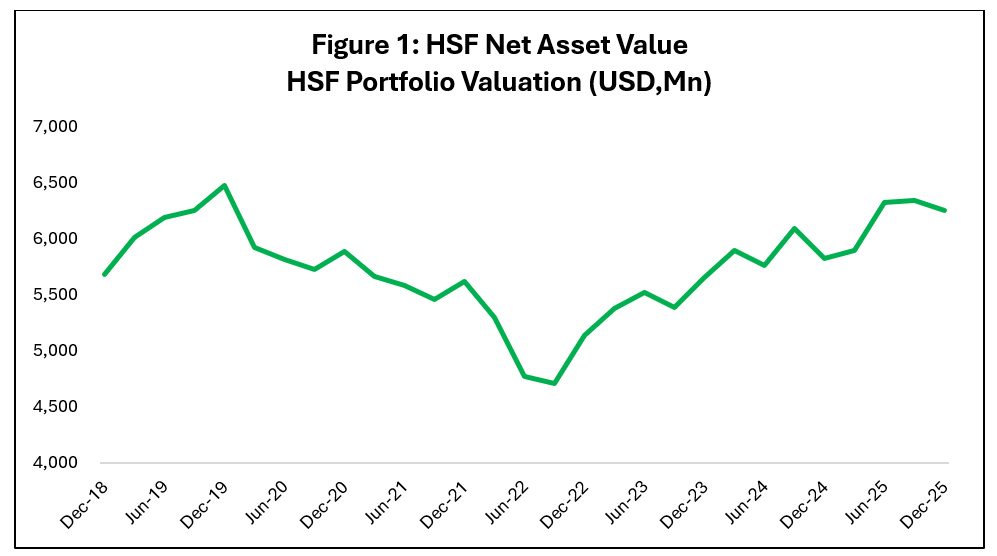
The Fund’s NAV increased substantially on a net basis from US$5.68 billion at December 2018 to US$6.25 billion at December 2025, although the period included material declines and recoveries resulting from both market movements and Government cash flows. The NAV of the HSF is influenced by both investment performance and Government cash flows. While positive investment returns increase the Fund’s value, contributions from excess petroleum revenues add to its assets, whereas authorised withdrawals reduce the Fund’s balance. Accordingly, changes in the NAV should be interpreted in the context of both market performance and deposits or withdrawals made under the HSF Act.
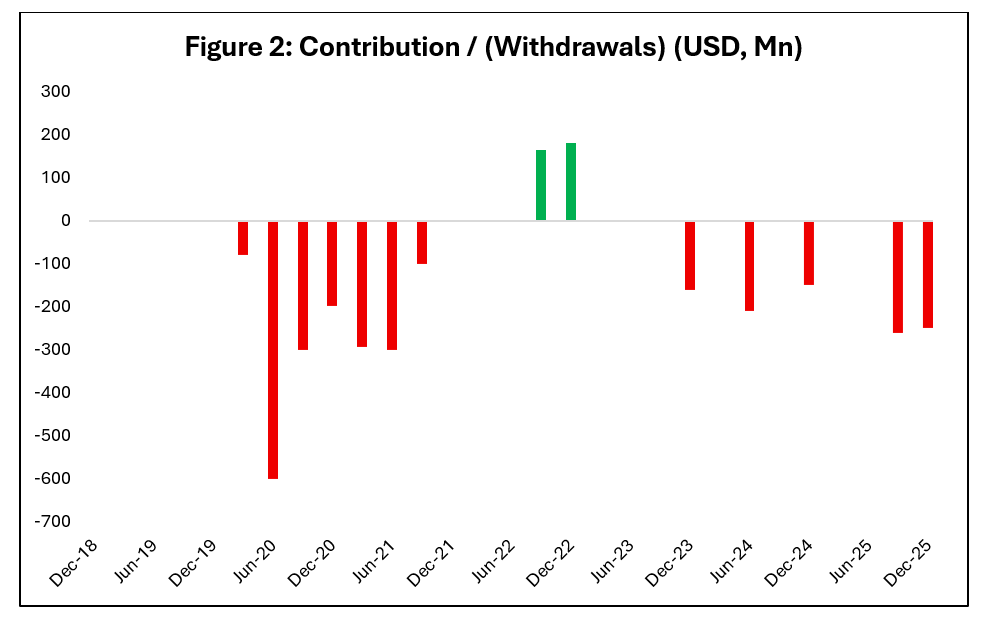
From 2020 to 2021, the Fund experienced a series of sizeable withdrawals, including a significant withdrawal of approximately USD600 million in 2020, followed by several additional withdrawals ranging between USD100 million and USD300 million. These withdrawals coincided with the economic challenges brought about by the COVID-19 pandemic and lower energy revenues. As a result, the Fund’s portfolio valuation declined from a peak of approximately USD6.48 billion in late 2019 to around USD5.45 billion by late 2021, reflecting both the reduction in assets from withdrawals and weaker global financial market performance during that period.
The trend reversed in 2022, when the Fund received net contributions of approximately USD165 million and USD182 million, supported by higher energy prices and stronger petroleum revenues. Together with improved investment returns as global markets recovered, these contributions helped lift the portfolio valuation above USD5.5 billion by early 2023.
However, from late 2023 through 2025, the Government resumed withdrawals from the Fund, with five withdrawals occurring over the period December 2023 to December 2025. Despite these outflows, the portfolio valuation continued to trend upward, reaching a new high of approximately USD6.34 billion in September 2025 before easing slightly to USD6.25 billion at December 2025. This suggests that the Fund’s investment returns more than offset the impact of the withdrawals, allowing the asset base to continue growing despite regular withdrawals.
Heritage and Stabilisation Fund Portfolio Composition
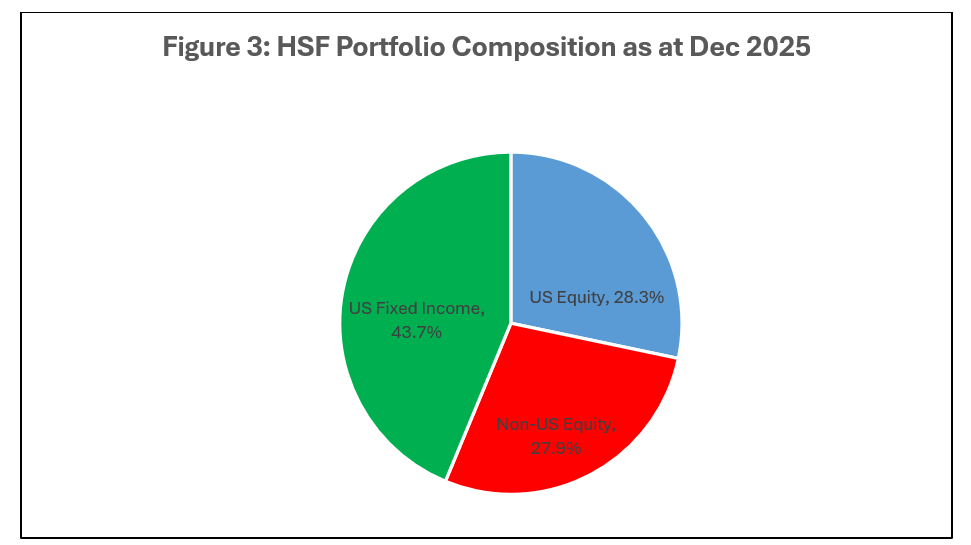
The HSF follows a diversified investment strategy by allocating its assets across both fixed income and equity investments. This approach aims to preserve capital, generate stable income, and achieve long-term growth while managing overall investment risk.
Equities represent the Fund’s largest asset class, accounting for 56% of the total portfolio value as at December 2025. The equity allocation is divided between U.S. Core Domestic Equity, which consists mainly of shares in large, established companies listed in the United States, and Non-U.S. Core International Equity, which provides exposure to companies operating in markets outside the United States. Together, these investments offer the Fund access to a broad range of industries, economies, and long-term growth opportunities.
The Fund’s fixed income allocation includes U.S. Short Duration Fixed Income, which consists of high-quality, U.S. dollar-denominated debt securities with relatively short maturities, generally between one and three years. These investments may include U.S. Treasury bills, government agency securities, corporate bonds, and other investment-grade instruments. The Fund is also invested in U.S. Core Domestic Fixed Income, which comprises a broader range of investment-grade U.S. bonds with medium- to long-term maturities, including U.S. Treasury securities, government agency bonds, mortgage-backed securities, corporate bonds, and asset-backed securities.
Source: Heritage and Stabilisation Fund Quarterly Investment Report, Oct to Dec 2025
Heritage and Stabilisation Fund Portfolio Performance
For the period December 2023 to December 2025, the HSF outperformed its benchmark in eight of the nine reporting periods, demonstrating consistent value added through active portfolio management.
The HSF generated a return of 8.08% in December 2023, exceeding the benchmark return of 7.71%. This trend continued throughout 2024, with the portfolio outperforming the benchmark by 0.83% on average. In 2025, the HSF underperformed the benchmark one time which was in March 2025, returning 1.27% versus the benchmark return of 1.86%. The HSF rebounded strongly thereafter, outperforming the benchmark by 2.33% in June 2025, 1.19% in September 2025, and 0.70% in December 2025.
Table 1: HSF Portfolio vs Benchmark Quarterly Returns

Key Risks and Future Outlook
Looking ahead, the performance of the HSF will be influenced primarily by developments in global financial markets, particularly equity markets, which accounted for approximately 56% of the Fund’s portfolio at December 2025. As a result, the Fund’s returns are closely linked to the performance of U.S. and international stock markets. Continued economic growth, strong corporate earnings, advances in technology, and easing monetary policy could support equity valuations and enhance the Fund’s long-term returns.
Conversely, elevated inflation, higher interest rates, geopolitical tensions, or a slowdown in global economic activity could weigh on equity markets and increase portfolio volatility. While the Fund’s diversified allocation across fixed income and equities helps mitigate risk, sustained weakness in global financial markets would likely moderate future growth in the Fund’s net asset value.
The Fund’s future growth will also depend on Trinidad and Tobago’s energy revenues and the Government’s fiscal position. As the HSF is funded primarily through excess petroleum revenues, stronger oil and natural gas prices, higher production levels, or new energy developments would support additional contributions and further strengthen the Fund’s asset base.
In contrast, lower energy prices, declining hydrocarbon production, or continued fiscal pressures could reduce future deposits and increase the need for withdrawals to support Government expenditure.
During such periods, the Fund’s dual mandate of providing fiscal stabilisation while preserving wealth for future generations may require careful balancing. Increased withdrawals during periods of economic stress could reduce the assets available for long-term investment, particularly if they coincide with weaker financial markets.
Despite these challenges, the HSF has demonstrated resilience through prudent investment management, a diversified portfolio, and a disciplined governance framework. Continued fiscal prudence and adherence to the Fund’s long-term objectives will remain important to preserving Trinidad and Tobago’s energy wealth and maintaining the HSF as a source of economic stability for future generations.
DISCLAIMER
First Citizens Bank Limited (hereinafter “the Bank”) has prepared this report which is provided for informational purposes only and without any obligation, whether contractual or otherwise. The content of the report is subject to change without any prior notice. All opinions and estimates in the report constitute the author’s own judgment as at the date of the report. All information contained in the report that has been obtained or arrived at from sources which the Bank believes to be reliable in good faith but the Bank disclaims any warranty, express or implied, as to the accuracy, timeliness, completeness of the information given or the assessments made in the report and opinions expressed in the report may change without notice. The Bank disclaims any and all warranties, express or implied, including without limitation warranties of satisfactory quality and fitness for a particular purpose with respect to the information contained in the report. This report does not constitute nor is it intended as a solicitation, an offer, a recommendation to buy, hold, or sell any securities, products, service, investment, or a recommendation to participate in any particular trading scheme discussed herein. The securities discussed in this report may not be suitable to all investors, therefore Investors wishing to purchase any of the securities mentioned should consult an investment adviser. The information in this report is not intended, in part or in whole, as financial advice. The information in this report shall not be used as part of any prospectus, offering memorandum or other disclosure ascribable to any issuer of securities. The use of the information in this report for the purpose of or with the effect of incorporating any such information into any disclosure intended for any investor or potential investor is not authorized.
DISCLOSURE
We, First Citizens Bank Limited hereby state that (1) the views expressed in this Research report reflect our personal view about any or all of the subject securities or issuers referred to in this Research report, (2) we are a beneficial owner of securities of the issuer (3) no part of our compensation was, is or will be directly or indirectly related to the specific recommendations or views expressed in this Research report (4) we have acted as underwriter in the distribution of securities referred to in this Research report in the three years immediately preceding and (5) we do have a direct or indirect financial or other interest in the subject securities or issuers referred to in this Research report.