Beyond the Boom: Building an Economy Before the Good Times Run Out
Commentary

Beyond the Boom: Building an Economy Before the Good Times Run Out
Natural resources can dramatically alter a country’s economic trajectory. Oil, natural gas, minerals and agricultural commodities can generate foreign exchange, government revenue and investment on a scale that might otherwise take decades to achieve. However, periods of resource-driven prosperity can also conceal a fundamental vulnerability, as the industry powering an economy today may not be able to do so indefinitely.
For resource-dependent economies, diversification therefore extends beyond simply increasing the number of industries operating domestically. The greater challenge is structural transformation, using the income, infrastructure, skills and investment generated during periods of prosperity to develop productive and internationally competitive sectors capable of sustaining growth when the traditional economic engine weakens.
Bolivia: When the Engine Begins to Stall
Bolivia’s natural gas boom played an important role in the country’s economic expansion during the 2000s and early 2010s. Strong hydrocarbon exports generated substantial foreign exchange and government revenue, supporting public expenditure, economic activity and improvements in social indicators. However, the vulnerabilities of this model became increasingly apparent as natural gas production and export earnings weakened. Bolivia earned approximately USD6.01bn from natural gas exports in 2014. By 2024, export earnings had fallen to approximately USD1.61bn, representing a decline of roughly 73% in nominal terms over the decade. The deterioration was not solely a price phenomenon, as declining production and export volumes also contributed to the weakening performance of the sector.
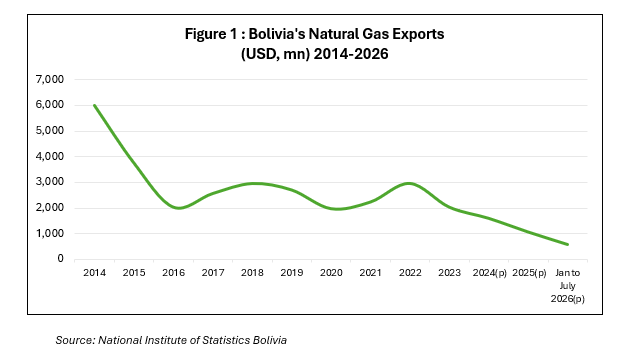
More recent estimates from the International Monetary Fund (IMF) suggest that this trend has continued. Natural gas exports declined from 4.5% of GDP in 2022 to 3.3% in 2023 and 2.3% in 2024, before falling to an estimated 1.8% of GDP in 2025. Total exports of goods and services similarly declined from 26.2% of GDP in 2022 to an estimated 16.0% in 2025. Meanwhile, gross international reserves were estimated at approximately USD2.2bn in 2025, equivalent to just two months of imports.
The consequences have extended well beyond the energy industry. Declining hydrocarbon production has reduced an important source of fiscal revenue and foreign exchange at the same time that Bolivia has faced substantial expenditure requirements and rising demand for imported fuels. Persistent fiscal deficits and dwindling economic buffers have therefore made adjustment increasingly difficult.
Natural gas itself was not Bolivia’s mistake. The sector contributed substantially to the country’s development during the boom years. Rather, Bolivia demonstrates the vulnerability that can emerge when alternative export and revenue-generating sectors do not expand sufficiently before the dominant resource begins to weaken.
The lesson is relatively straightforward: diversification becomes considerably more challenging once the revenues that could have helped finance the transformation are already dissipating.
Mauritius: Transform Before You Have To
Mauritius provides a markedly different experience of economic transformation. At independence in 1968, the small island economy was heavily dependent on sugar, leaving economic activity, exports and employment vulnerable to developments in a single commodity. Rather than abandoning an industry in which it possessed a comparative advantage, Mauritius progressively used its existing economic base to facilitate the development of new sources of growth. The establishment of an Export Processing Zone (EPZ) in 1970 supported the expansion of export-oriented manufacturing, particularly textiles and garments, while tourism developed into an increasingly important source of foreign exchange. Over time, the economy continued to evolve beyond these industries, expanding into financial services, information and communications technology and other service-based activities. The result was a gradual transition from an agriculture-dominated economy toward a considerably more diversified, services-oriented economic structure.
This transformation occurred alongside a significant improvement in the country’s economic position and living standards. According to the IMF, Mauritius has recorded average economic growth of approximately 5% over the past 50 years, supporting its transition from an agricultural economy to a diversified upper-middle-income country. More recently, GDP per capita increased from approximately USD9,011 in 2020 to USD11,994 in 2024 and USD12,935 in 2025, with the IMF projecting it to rise further to approximately USD13,701 in 2026.
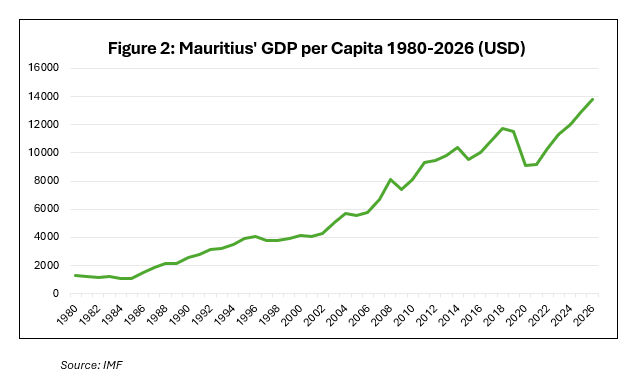
The upward trajectory in GDP per capita should not be interpreted as the product of diversification alone. Rather, it illustrates the broader economic development that occurred alongside Mauritius’ structural transformation. Importantly, the country did not simply replace sugar with another dominant industry. Manufacturing was complemented by tourism and subsequently by financial and other services, allowing the economy to develop multiple sources of activity and foreign exchange.
The process remains ongoing. Real GDP expanded by 3.2% in 2025, supported by continued strength in services, including tourism and financial services. However, the IMF expects growth to moderate to 2.8% in 2026, while high public debt, demographic pressures and relatively weak productivity growth present longer-term challenges. Labour productivity growth has averaged approximately 2.4% annually since 2010, compared with around 4.2% among upper-middle-income economies, highlighting the need for further improvements in competitiveness, investment and innovation.
Mauritius therefore does not represent a finished diversification story. Instead, its experience demonstrates that structural transformation is an ongoing process of developing new sources of comparative advantage before existing ones become insufficient to sustain economic progress. Its transition from sugar to manufacturing, tourism, finance and other services provide an example of how a small economy can progressively broaden its productive base while continuing to adapt to new economic challenges.
Trinidad and Tobago: Diversified, But How Far?
Trinidad and Tobago (T&T) presents a more nuanced picture of economic diversification. Hydrocarbons have played a central role in the country’s development, but T&T did considerably more than simply extract and export oil and natural gas. The country moved downstream into liquefied natural gas (LNG), ammonia, methanol and petrochemicals, developing one of the Caribbean’s most sophisticated industrial energy complexes. This represented meaningful diversification within the hydrocarbon value chain. However, diversification of domestic production is not necessarily equivalent to diversification of a country’s sources of foreign exchange, and the distinction remains particularly evident in T&T.
In 2025, the energy sector accounted for approximately 20.9% of nominal GDP, compared with 79.1% for the non-energy sector. This suggests that from a domestic production perspective, T&T has developed a considerably broader economic base beyond energy. Exports, however, tell a markedly different story. Energy exports were equivalent to 31.6% of GDP in 2025 and accounted for approximately 80% of the country’s merchandise exports, despite generating only around one-fifth of nominal GDP.
Government finances also remain exposed to the sector. In FY2025, energy revenue amounted to 9.9% of GDP, while total budgetary revenue stood at 26.9% of GDP. Energy therefore accounted for approximately 32.5% of total budgetary revenue, compared with 67.5% from non-energy sources.
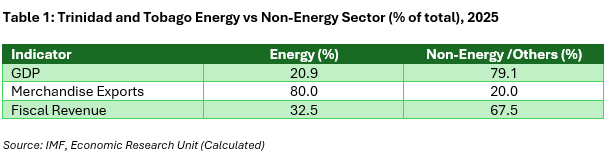
These figures highlight an important distinction. T&T’s domestic economy is substantially more diversified than its external earnings. Non-energy industries can generate domestic output and employment, but many do not generate foreign exchange on the scale of LNG, ammonia, methanol and other energy-based exports. For a small open economy that relies heavily on imports, this difference is particularly important. Recent economic performance reinforces this point. Real GDP expanded by an estimated 0.8% in 2025, supported by 1.2% growth in the non-energy economy, while energy-sector output contracted by 0.5%. The IMF projects overall growth of 0.8% in 2026, with the non-energy sector expanding by 2.6% while energy output is projected to contract by 4.5%. The non-energy economy is therefore increasingly important to domestic growth, even as energy remains disproportionately important to the country’s external and fiscal position.
The maturity of the energy sector also adds urgency to the diversification challenge. Lower oil and gas production from mature fields and potential delays to new energy projects remain important risks to economic growth and the external sector. At the same time, the country’s current account surplus narrowed considerably from the levels recorded during the earlier energy boom, reaching an estimated 3.1% of GDP in 2025, while net official reserves declined to approximately USD5.37bn, equivalent to 6.1 months of prospective imports.
T&T nevertheless possesses an important advantage accumulated from decades of energy production: significant financial and institutional buffers. Assets in the Heritage and Stabilisation Fund stood at approximately USD6.6bn as of June 2026, providing an additional cushion against external and fiscal shocks. The challenge facing T&T is therefore not that the country failed to derive value from its hydrocarbon resources. It clearly did. Instead, the next stage of diversification requires ensuring that more of the non-energy economy becomes tradable – capable of generating exports, attracting investment and earning foreign exchange independently of the energy sector.
Tourism, financial and business services, digital services, agriculture and agro-processing, creative industries, maritime services and other knowledge-intensive activities provide potential avenues. However, identifying sectors is considerably easier than developing internationally competitive industries. Productivity, skills, infrastructure, innovation, access to finance and the overall business environment will ultimately determine whether these activities can develop into meaningful new sources of external earnings.
Conclusion
The experiences of Bolivia, Mauritius and T&T demonstrate the importance of turning periods of resource and commodity strength into opportunities for long-term economic transformation. Bolivia highlights the vulnerabilities that emerge when diversification lags behind a weakening export engine, while Mauritius illustrates how continuously developing new sources of competitiveness can support economic resilience over time. For T&T, the next stage of transformation requires a stronger focus on internationally competitive, foreign-exchange-earning industries. The country can leverage its infrastructure, industrial expertise, human capital and financial resources to support this transition while continuing to maximise the value of its energy sector. The window for transformation is most valuable while the resources, capacity and flexibility to shape what comes next are still available.
DISCLAIMER
First Citizens Bank Limited (hereinafter “the Bank”) has prepared this report which is provided for informational purposes only and without any obligation, whether contractual or otherwise. The content of the report is subject to change without any prior notice. All opinions and estimates in the report constitute the author’s own judgment as at the date of the report. All information contained in the report that has been obtained or arrived at from sources which the Bank believes to be reliable in good faith but the Bank disclaims any warranty, express or implied, as to the accuracy, timeliness, completeness of the information given or the assessments made in the report and opinions expressed in the report may change without notice. The Bank disclaims any and all warranties, express or implied, including without limitation warranties of satisfactory quality and fitness for a particular purpose with respect to the information contained in the report. This report does not constitute nor is it intended as a solicitation, an offer, a recommendation to buy, hold, or sell any securities, products, service, investment, or a recommendation to participate in any particular trading scheme discussed herein. The securities discussed in this report may not be suitable to all investors, therefore Investors wishing to purchase any of the securities mentioned should consult an investment adviser. The information in this report is not intended, in part or in whole, as financial advice. The information in this report shall not be used as part of any prospectus, offering memorandum or other disclosure ascribable to any issuer of securities. The use of the information in this report for the purpose of or with the effect of incorporating any such information into any disclosure intended for any investor or potential investor is not authorized.
DISCLOSURE
We, First Citizens Bank Limited hereby state that (1) the views expressed in this Research report reflect our personal view about any or all of the subject securities or issuers referred to in this Research report, (2) we are a beneficial owner of securities of the issuer (3) no part of our compensation was, is or will be directly or indirectly related to the specific recommendations or views expressed in this Research report (4) we have acted as underwriter in the distribution of securities referred to in this Research report in the three years immediately preceding and (5) we do have a direct or indirect financial or other interest in the subject securities or issuers referred to in this Research report.