The Road Ahead: Trinidad and Tobago’s Fiscal Crossroads
Commentary

Against the backdrop of the recently presented National Budget, differing and often opposing assessments of the Trinidad and Tobago (T&T) economy and its fiscal performance have fuelled widespread speculation about the country’s economic realities. The domestic economy has historically mirrored the performance of the global energy markets – not surprising, given the country’s dependence on its energy sector. The energy markets continue to display a high degree of volatility as they are increasingly affected by geopolitics and other factors in the global space. In its June 2026 Article IV Consultation Report, the International Monetary Fund (IMF) noted that T&T’s persistent fiscal deficits have led to an increase in public debt and highlighted the importance of placing debt on a credible downward path. This article will provide some insights into the historical trends in T&T’s fiscal accounts and the evolution of the fiscal balances and indebtedness.
Historical Trends in Fiscal Shortfalls and Public Debt
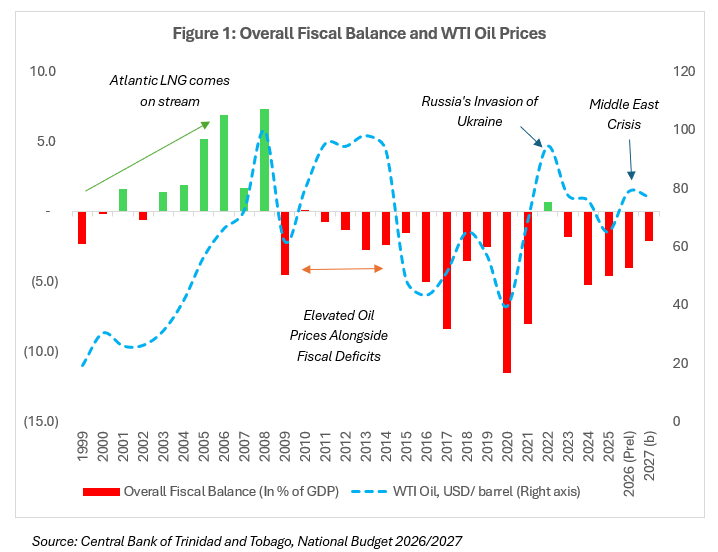
Since fiscal year (FY) 1999, government revenue closely reflects global oil prices, with a correlation of close to 85%. During the period 1999 – 2008, the fiscal balance averaged a surplus of 2.3%, peaking at 7.3% of GDP in 2008. The strong uptick in government revenue largely reflected the transformational impact of Atlantic LNG on the country’s energy sector. The buoyant oil prices in the subsequent years helped to support government revenue until 2014 when the global energy markets tanked, resulting in a sharp decline in global prices. During the period 2014 – 2019, government revenue fell by 20%, while fiscal consolidation efforts led to a decline in expenditure by roughly the same magnitude. The result was a contraction in the economy by an average of 1.6% during the period.
Even before global energy market turned in 2014, Trinidad and Tobago’s fiscal balance was recording successive shortfalls three years prior, with only a small surplus of 0.7% of GDP in 2022, when Russia invaded Ukraine, resulting in a spike in global energy prices, benefitting government revenue. Since then, the fiscal deficit has widened to 4.6% of GDP in FY 2025 and an estimated 4% of GDP in FY 2026.
The recently presented National Budget for FY 2027 assumes an oil price of USD77 per barrel and natural gas price of USD5 per mmbtu. Total government revenue for the new fiscal year is approximately 10% higher than the revised estimates for FY 2026, while expenditure is budgeted to be 3.5% higher. Due to an expected increase in energy revenue, together with proposed revenue-raising measures, the fiscal deficit is forecasted to fall to 2.1% of GDP in FY 2027, moving from an estimated TTD7 billion to TTD3.64 billion.
The fiscal shortfalls over the years have led to large financing needs and an accumulation of government debt, which have been filled through various sources, including domestic and external borrowing, divestment of state assets, withdrawals from the country’s sovereign wealth fund (HSF) and other multilateral borrowing.
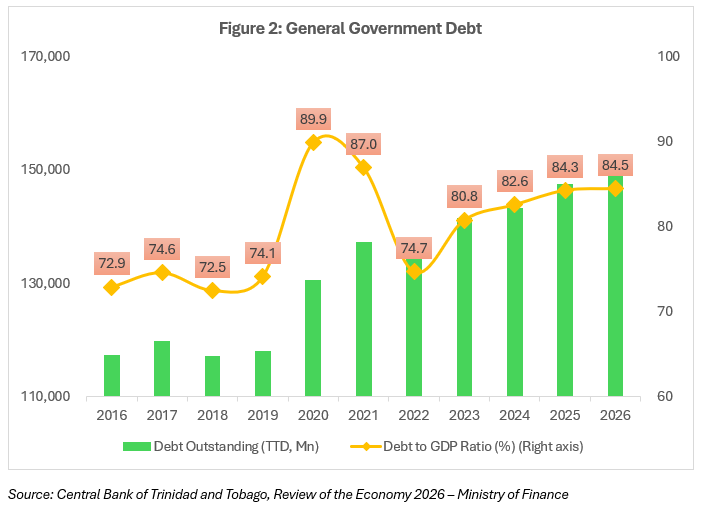
During the period FY 2016 to FY 2026, general government debt outstanding rose by TTD34 billion – an increase of almost 30%, to around TTD151 billion. The biggest jump in debt came with the COVID-19 pandemic, where outstanding debt rose by 17% between 2019 and 2022. The debt to GDP ratio surged to 90% in FY 2020 largely due to the rise in borrowing, as well as the sharp decline in GDP. With GDP growth returning in the subsequent years between 2022-2024, the ratio started to trend down, reaching 74.7% in FY 2022, but since has since started to climb, ending FY 2026 at 84.5%. Domestic debt constitutes 71.5% of government debt, while external debt accounts for the 27.7%
Building Fiscal Safety Nets
In the June 2026 Article IV Consultation report, the IMF recommended that “the windfall from the elevated energy prices should be used to reduce debt, rebuild buffers, including resuming deposits into the Heritage and Stabilisation (HSF), while allowing targeted and temporary support to protect vulnerable households.”
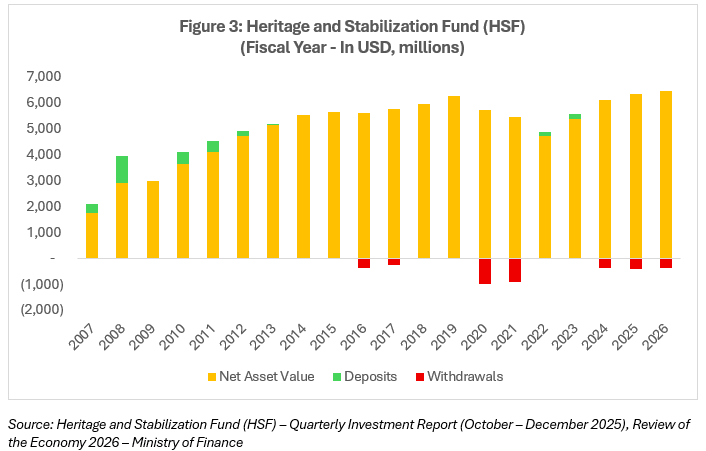
Since FY 2007, the central government has collected approximately TTD288 billion in oil revenue while during the same period, approximately TTD20 billion was deposited into the HSF – approximately 7% of total oil revenue during the period. The HSF, which was formalized in 2007, has benefitted from a total of USD2.9 billion in deposits over the period, compared to total withdrawals of USD3.7 billion, with the largest withdrawal during the COVID-19 pandemic in FY 2020 and FY 2021, when USD1.9 billion was withdrawn. The last deposits into the HSF were in FY 2022 and 2023 totaling USD346 million. Since FY 2024, withdrawals have totaled USD1.2 billion. The role of the HSF is critical for an economy such as T&T’s whose economic fortunes are directly linked to the volatile energy markets. The fund is an important financial buffer and a critical countercyclical fiscal policy tool, once used responsibly. During periods of lower energy prices, it can and has been used to mitigate against sharp fiscal adjustments, which can further curb economic activity and result in a much larger economic contraction, whilst during high prices, it can be used to improve fiscal flexibility and accumulate fiscal reserves. In this regard, the HSF remains a fundamental fiscal shock absorber for the T&T economy.
Cautious Optimism but Significant Challenges Remain
The government has signaled expectations for higher government revenues, given the higher energy price assumptions that underpin the budget. There are some bright shoots during the latter half of 2027 as well, with encouraging developments in the energy sector, as several large projects are expected to boost domestic gas supply. The potential for greater output bodes well for T&T, especially at a time when demand is expanding globally. The supply outlook for 2027 is bolstered by Shell’s Manatee project, bpTT’s Ginger gas field, Shell’s Aphrodite project as well as the Coconut project which is a joint venture between bpTT and EOG Resources. In addition to these, the possibility for cross-border arrangements with Venezuela is significant and will be transformational if realized. These energy sector developments can potentially boost natural gas production from the current levels, which has averaged around 2,586 mmcf/ day over the past five years, compared to an average of 3,380 mmcf/d during the previous 5-year period (2016-2020).
In the Budget Statement presented on 12 October 2026, it was noted that the Ministry of Finance (MoF) is exploring a National Fiscal Responsibility and Resilience Framework as well as an annual Fiscal Strategy Statement intended to outline the government’s medium term fiscal objectives, as well as the economic and fiscal assumptions that support these objectives. The document is also intended to provide details on expectations for revenue, expenditure, the fiscal balance, and debt, as well as the associated risks.
One of the recommendations from the IMF was for the adoption of a medium-term fiscal framework ‘anchored by a well-designed fiscal rule and a credible anchor to manage volatile energy revenues and ensure intergenerational wealth’. If the MoF’s plan becomes a reality, it will bode well for transparency and accountability in addition to providing a clearer path to fiscal sustainability, once designed properly. A strong fiscal framework will assist in sustainably reducing the country’s debt burden and improve fiscal flexibility.
In its October 2026 update of the World Economic Outlook (WEO), the IMF projected that the T&T economy will grow by 0.2% in 2026, from a contraction of 0.5% in 2025. Further, the medium-term outlook looks more optimistic with expectations for real GDP growth of 2.2%, 3.1% and 2.8% in 2027, 2028 and 2029, respectively. Economic diversification remains a key factor to mitigate against energy sector volatility, and it is encouraging that the budget outlines intentions to increase tourism’s contribution to GDP from 6% to 12% by 2030 as well as the progression of the Revitalisation Blueprint. With anticipation of a gradual economic turnaround towards the second half of 2027, largely driven by the energy sector, T&T must consider how the energy windfall (if realized) can be utilized efficiently to bolster the country’s fiscal and economic resilience to place the country on a more sustainable path of development.
DISCLAIMER
First Citizens Bank Limited (hereinafter “the Bank”) has prepared this report which is provided for informational purposes only and without any obligation, whether contractual or otherwise. The content of the report is subject to change without any prior notice. All opinions and estimates in the report constitute the author’s own judgment as at the date of the report. All information contained in the report that has been obtained or arrived at from sources which the Bank believes to be reliable in good faith but the Bank disclaims any warranty, express or implied, as to the accuracy, timeliness, completeness of the information given or the assessments made in the report and opinions expressed in the report may change without notice. The Bank disclaims any and all warranties, express or implied, including without limitation warranties of satisfactory quality and fitness for a particular purpose with respect to the information contained in the report. This report does not constitute nor is it intended as a solicitation, an offer, a recommendation to buy, hold, or sell any securities, products, service, investment, or a recommendation to participate in any particular trading scheme discussed herein. The securities discussed in this report may not be suitable to all investors, therefore Investors wishing to purchase any of the securities mentioned should consult an investment adviser. The information in this report is not intended, in part or in whole, as financial advice. The information in this report shall not be used as part of any prospectus, offering memorandum or other disclosure ascribable to any issuer of securities. The use of the information in this report for the purpose of or with the effect of incorporating any such information into any disclosure intended for any investor or potential investor is not authorized.
DISCLOSURE
We, First Citizens Bank Limited hereby state that (1) the views expressed in this Research report reflect our personal view about any or all of the subject securities or issuers referred to in this Research report, (2) we are a beneficial owner of securities of the issuer (3) no part of our compensation was, is or will be directly or indirectly related to the specific recommendations or views expressed in this Research report (4) we have acted as underwriter in the distribution of securities referred to in this Research report in the three years immediately preceding and (5) we do have a direct or indirect financial or other interest in the subject securities or issuers referred to in this Research report.