A Small World After All?
The Economics of Interdependence
Commentary

There is a saying in the Caribbean, “When America sneezes, the Caribbean catches a cold.” Although often used casually, it says quite a lot about how closely our economies are connected. A slowdown in the United States (US) can reduce tourism demand across the Caribbean, while changes in global energy production can affect trade in other parts of the world. Similarly, changes in international commodity prices and interest rates can affect inflation, government finances and economic growth.
However, these connections can also have positive effects. Higher demand from other countries can increase exports, while changes in global supply can create opportunities for producers in other markets. This is economic interdependence at work, where developments in one economy can have consequences for another, whether positive or negative.
When these developments affect economic conditions across borders, they are known as macroeconomic spillovers. For small, open Caribbean economies, the effects have a greater impact, given their reliance on external markets for trade, tourism and financing.
Economic Interdependence in Practice
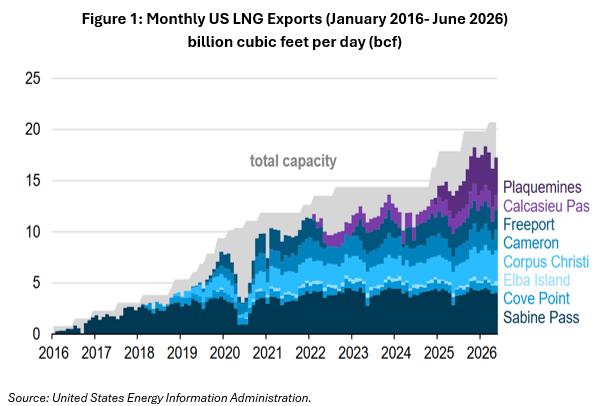
Changes in global production and trade help show how these economies are connected. Take the global liquefied natural gas (LNG) market. According to the US Energy Information Administration (EIA), US LNG exports averaged 17.4 billion cubic feet per day (Bcf/d) during the first half of 2026 (H1’2026), an increase of 23.0% compared to the corresponding period in 2025, supported by additions to export capacity (Figure 1).
By September 2026, US LNG exports had reached 10.9 million metric tonnes, up from 10.7 million tonnes in August. According to Reuters, Europe received 5.91 million tonnes, or 54.0% of total shipments, while Asia accounted for approximately 26.0%. However, exports to Latin America declined from 0.9 million tonnes to 0.53 million tonnes over the same period.
Trinidad and Tobago (T&T) was part of that change. Reuters reported that increased Trinidadian LNG shipments displaced some US cargoes in Latin America, freeing up supplies for other markets where prices were more attractive.
Higher LNG supply from T&T influenced demand for US shipments in Latin America and contributed to changes in international trade flows. The example also shows that smaller economies are not always simply responding to developments abroad, as changes in their own production can influence regional markets.
When Another Country’s Slowdown Becomes Your Own…
Trade is one of the most direct ways economic weaknesses can spread. When growth slows in a major economy, households may cut back on spending and businesses may reduce investment. Demand for imported goods can weaken, along with spending on overseas travel.
This matters especially for the Caribbean, where tourism remains an integral source of external demand. According to the Caribbean Development Dynamics Report 2026 by the Organisation for Economic Co-operation and Development (OECD) and the Inter-American Development Bank (IDB), services trade averaged about 45.7% of GDP across Caribbean economies in 2024, while travel accounted for 71.0% of total services exports in 2023. The report also highlighted the growth of the tourism industry, with annual stay-over tourist arrivals increasing from approximately 10 million in 1995 to 34.2 million in 2024.
More recently, the Caribbean Tourism Organization (CTO) estimated that international stay-over arrivals increased by a further 2.5% in 2025 to approximately 35.0 million visitors, around 900,000 more than in 2024.
While tourism supports regional economic activity, its importance also creates exposure to changes in external demand. In 2022, tourism spending accounted for approximately 32.0% of regional economic output. Given the industry’s links to accommodation, transportation, and other services, changes in visitor spending can also affect employment, government revenue, and overall GDP growth.
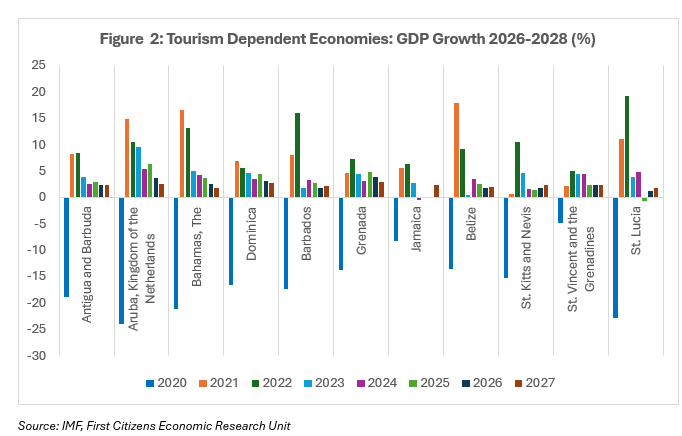
The COVID-19 pandemic demonstrated how severe these effects could become. Although the pandemic was a global shock, tourism-dependent Caribbean economies were particularly exposed to the collapse in international travel. In 2020 real GDP contracted by approximately 22.9% in St. Lucia, 17.4% in Barbados, and 21.1% in the Bahamas (Figure 2), according to the IMF figures.
This relationship is not new. In his 1979 Nobel Prize lecture, The Slowing Down of the Engine of Growth, St Lucian economist Sir Arthur Lewis observed:
“When the developed grows fast the developing grows fast, and when the developed slows down, the developing slows down.”
Nearly five decades later, his observation remains relevant. Across IMF Article IV reports for Caribbean tourism-dependent economies, a recurring risk is that weaker growth in major source markets could reduce visitor arrivals and weigh on economic activity.
When a Price Shock Crosses Borders:
Not every external shock arrives through weaker demand. Sometimes, it arrives at your gas station pump, in your supermarkets or your electricity bills. The Russia–Ukraine war demonstrated how disruptions in commodity-producing economies can affect prices elsewhere. In April 2022, the World Bank described the resulting developments as the largest commodity shock since the 1970s. Energy price increases were the largest since the 1973 oil crisis, while food and fertilizer prices recorded their largest increases since 2008.
For countries that import commodities, the impact goes beyond higher global prices. Higher energy prices make transportation, electricity and production more expensive, while rising fertilizer prices increase farming costs. These higher costs can then lead to increases in food prices and other goods.
The Caribbean’s heavy reliance on imported food adds to this exposure. According to the United Nations Sustainable Development Goals (UNSDG), the Caribbean remains one of the most food import-dependent regions in the world, with annual food imports exceeding USD6.0 billion. This dependence means that increases in global food prices and shipping costs can also raise import expenditure and place additional pressure on external balances.
The 2026 Middle East conflict has brought similar concerns back into focus, with disruptions to energy supplies and shipping routes affecting international commodity markets.
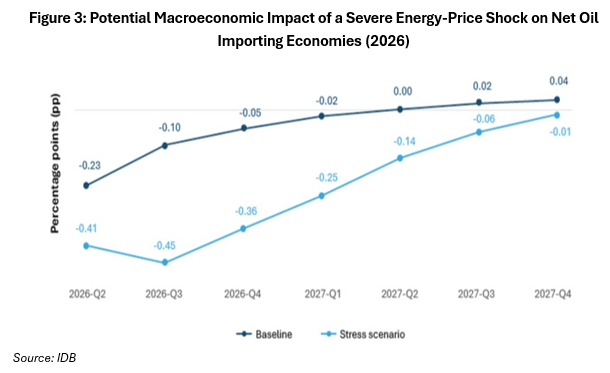
In May 2026, the Inter-American Development Bank (IDB) assessed the potential macroeconomic effects of the conflict on Latin America and the Caribbean. Under a severe energy-price scenario, GDP growth in net oil-importing economies could decline by as much as 1.2 percentage points (pp) in 2026, while fiscal deficits could widen by between 0.5 and 1.6 pp of GDP. The terms of trade could also deteriorate by as much as 4.2 pp, reflecting higher import costs relative to export earnings.
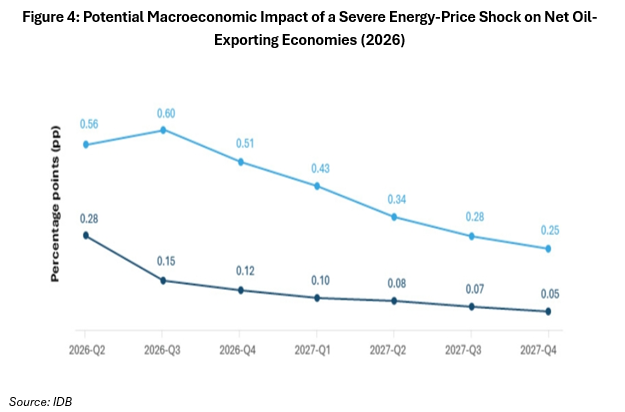
Would the same development affect every Caribbean economy in the same way? Not necessarily. For net oil exporters, the effects could move in the opposite direction. Under the IDB’s severe scenario, economic growth could increase by as much as 1.7 pp, while fiscal balances could improve by up to 1.8 pp of GDP through higher oil revenues and royalties.
The IMF has similarly noted that energy-producing economies such as Guyana and T&T could benefit from higher commodity prices through stronger external balances and government revenues. However, these gains do not necessarily translate into stronger economic growth, particularly where production constraints remain. For economies heavily dependent on oil and gas, higher export earnings may improve their short-term economic position without reducing their reliance on the energy sector, leaving them exposed to future price declines.
Tourism-dependent Caribbean economies face a different situation. According to the IMF, net energy imports average approximately 6.0% of GDP in these economies, leaving them particularly exposed to higher fuel costs, especially where public debt is already high and fiscal space is limited.
More recently, Reuters reported in October 2026 that shipping and insurance costs for energy shipments had risen sharply amid continued disruptions in the Middle East. These developments show how the effects can extend beyond energy markets, with higher transportation costs adding to inflationary pressures and import expenditure in fuel-importing economies.
Although the IDB’s estimates are scenario-based rather than realized outcomes, they illustrate how the same international price shock can have markedly different macroeconomic consequences across the region.
When Global Borrowing Costs Become Everyone’s Business…
On October 1, 2026, the benchmark US 10-year Treasury yield reached approximately 5.34%, its highest level since 2002. US Treasury yields serve as an important benchmark for global borrowing costs, meaning changes can influence the cost of raising new debt in other economies.
For developing countries already carrying high public debt, more expensive borrowing can place additional pressure on government finances, particularly when existing obligations need to be refinanced.
According to the Ministry of Finance of St. Vincent and the Grenadines, external debt stood at XCD2.604 billion in Q2’2026 and accounted for 72.4% of total public debt. Currency composition also shows a sizeable exposure to the US dollar (Figure 5). The share of USD-denominated debt increased from 68.4% in Q1’2026 to 69.3% of the external portfolio in Q2’2026, while 27.4% of the portfolio was subject to floating interest rates.
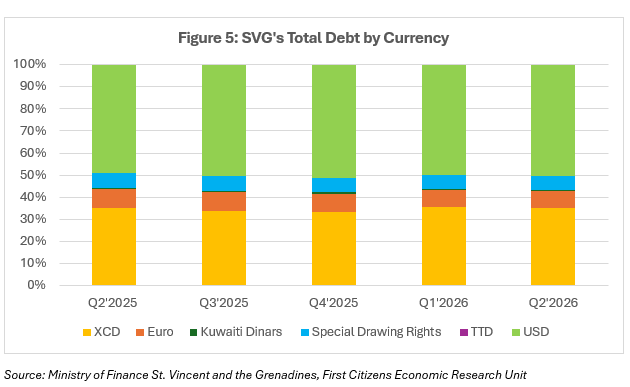
These figures are particularly relevant when considered alongside SVG’s wider fiscal position. According to the IMF’s 2026 Article IV consultation, public debt reached approximately 113.1% of GDP in 2025, having increased by around 45 pp since 2019. Repeated external shocks, including the COVID-19 pandemic and major natural disasters, have contributed to widening fiscal deficits and rising debt.
Although higher US Treasury yields do not automatically increase SVG’s debt-servicing costs, prolonged tightening in global financing conditions could make new borrowing and refinancing more expensive. Floating-rate obligations may also become costlier depending on movements in their reference rates. However, the importance of multilateral and bilateral financing provides some protection against direct changes in market interest rates.
For an economy already facing substantial debt pressures, higher financing costs could further constrain fiscal space, leaving fewer resources for reconstruction, infrastructure and other development priorities. This demonstrates how changes in international financing conditions can affect domestic public finances.
Conclusion:
As the examples show, economic interdependence brings both opportunities and vulnerabilities. Whether through tourism, commodity markets or global financing conditions, developments abroad can influence economic performance at home, although the effects differ depending on each country’s economic structure and exposure to external markets.
For small, open Caribbean economies, the challenge is not to avoid these connections, but to become better positioned to manage them. Greater economic diversification, sound fiscal management and stronger external buffers can help reduce vulnerability while allowing countries to benefit from international opportunities.
Perhaps the old saying about America sneezing still holds some truth, but how badly the Caribbean catches a cold also depends on how well prepared its economies are.
DISCLAIMER
First Citizens Bank Limited (hereinafter “the Bank”) has prepared this report which is provided for informational purposes only and without any obligation, whether contractual or otherwise. The content of the report is subject to change without any prior notice. All opinions and estimates in the report constitute the author’s own judgment as at the date of the report. All information contained in the report that has been obtained or arrived at from sources which the Bank believes to be reliable in good faith but the Bank disclaims any warranty, express or implied, as to the accuracy, timeliness, completeness of the information given or the assessments made in the report and opinions expressed in the report may change without notice. The Bank disclaims any and all warranties, express or implied, including without limitation warranties of satisfactory quality and fitness for a particular purpose with respect to the information contained in the report. This report does not constitute nor is it intended as a solicitation, an offer, a recommendation to buy, hold, or sell any securities, products, service, investment, or a recommendation to participate in any particular trading scheme discussed herein. The securities discussed in this report may not be suitable to all investors, therefore Investors wishing to purchase any of the securities mentioned should consult an investment adviser. The information in this report is not intended, in part or in whole, as financial advice. The information in this report shall not be used as part of any prospectus, offering memorandum or other disclosure ascribable to any issuer of securities. The use of the information in this report for the purpose of or with the effect of incorporating any such information into any disclosure intended for any investor or potential investor is not authorized.
DISCLOSURE
We, First Citizens Bank Limited hereby state that (1) the views expressed in this Research report reflect our personal view about any or all of the subject securities or issuers referred to in this Research report, (2) we are a beneficial owner of securities of the issuer (3) no part of our compensation was, is or will be directly or indirectly related to the specific recommendations or views expressed in this Research report (4) we have acted as underwriter in the distribution of securities referred to in this Research report in the three years immediately preceding and (5) we do have a direct or indirect financial or other interest in the subject securities or issuers referred to in this Research report.