Market Review: Third Quarter of 2026
International Market Review
Global equity markets delivered a subdued performance during the third quarter of 2026, after growing by double-digits in the prior quarter, with the MSCI World index increasing marginally by 1.60% in Q3’2026 compared to 13.32% in Q2’2026. Investor sentiment was increasingly shaped by geopolitical tensions, movements in oil prices, concerns surrounding Artificial Intelligence (AI) valuations and changing expectations for global interest rates.
The quarter began on uncertain footing, with most major global equity indices declining in July or recording only modest gains. Renewed tensions in the Middle East and rising oil prices weighed on investor confidence, as markets became increasingly concerned about the potential impact of higher energy costs on inflation and economic growth. Sentiment was also affected by questions surrounding the elevated valuations of AI-related companies. In particular, investors questioned whether the substantial capital expenditure required to support the continued expansion of AI could be sustainably financed from companies’ internally generated cash flows.
Market conditions improved in August, with global equities recovering much of the weakness recorded in July. Technology shares strengthened as software companies and other beneficiaries of AI regained investor interest, supported by strong corporate results from Nvidia. The AI rally also began to broaden beyond semiconductor companies to include software providers and businesses adopting AI technologies to improve productivity and operations. At the same time, diplomatic progress surrounding the Strait of Hormuz eased concerns over potential disruptions to global oil supplies, providing additional support to investor sentiment.
However, the recovery proved short-lived. Global equity markets came under renewed pressure in September as escalating tensions in the Middle East and increased reports of attacks heightened concerns over global energy supplies. The resulting surge in oil prices to above USD100 per barrel revived fears that higher energy costs could fuel another wave of inflation.
Investor sentiment weakened further following the U.S. Federal Reserve’s September interest-rate decision to raise the Fed Funds rate by 25 basis points, which led investors to revise their expectations for the future path of interest rates. Expectations that interest rates would remain higher pushed government bond yields across major global markets to multiyear highs. Higher bond yields, in turn, placed downward pressure on equity valuations, particularly for technology and other high-growth companies, whose share prices tend to be more sensitive to changes in interest rates.
U.S.
U.S. equities posted modest returns in Q3’2026 compared to the prior quarter as the strong investor momentum seen earlier in the year began to lose steam. U.S. stocks reached an all-time high in August, supported by resilient economic data and strong corporate earnings, particularly within the technology sector. However, these gains proved difficult to sustain, however, as rising geopolitical risks and changing interest-rate expectations weighed on investor confidence.
Technology stocks were particularly sensitive to the deterioration in market sentiment. The sector came under pressure amid calls from some AI industry executives for a slower pace of artificial intelligence development. Investors also became increasingly concerned that higher interest rates and energy costs could weaken economic growth and make it more difficult for technology companies to sustain their significant AI-related capital expenditure.
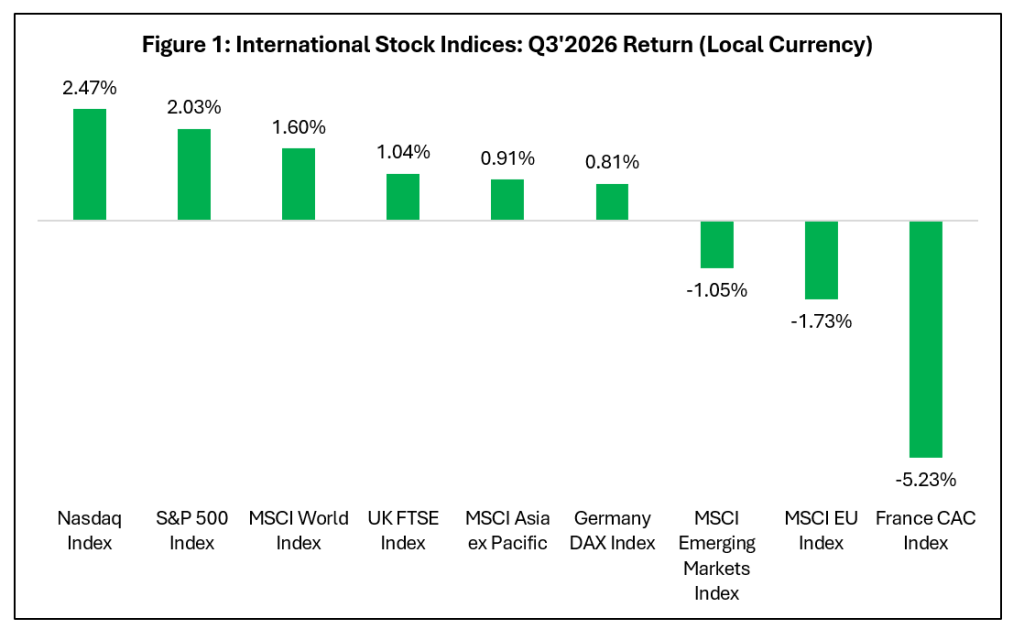
As a result, for the third quarter of 2026, the S&P 500 Index and the NASDAQ index posted returns of 2.03% and 2.47% respectively, compared with 14.87% and 21.41% in the prior quarter.
Europe and the U.K.
European equities, as measured by the MSCI Europe Index, delivered a weaker performance in the third quarter of 2026 compared with the previous quarter, as renewed inflationary pressures weighed on investor sentiment. Higher energy prices, together with weather-related disruptions to food supplies, increased concerns that inflation could remain elevated for longer. Euro-area headline inflation accelerated to 3.8% year-on-year in September 2026, up from 3.2% in August 2026. Against this backdrop, the European Central Bank (ECB) raised its key interest rate by 25 basis points in September, marking its second increase for the year as policymakers sought to contain renewed price pressures.
Among the major European markets, German equities were a relative bright spot, with the DAX reaching fresh highs during the quarter. The market was supported by resilient export orders, which provided some reassurance over the outlook for Germany’s export-oriented corporate sector despite the more challenging regional environment.
French equities, by contrast, were held back by continued fiscal and political uncertainty. Prime Minister Sébastien Lecornu’s minority government faced difficult negotiations over the 2027 budget in a divided National Assembly, where no single political grouping held a clear majority. The fragmented political landscape increased uncertainty over the government’s ability to secure support for measures aimed at reducing France’s fiscal deficit. Investors were also mindful of the possibility that prolonged political disagreements could delay fiscal reforms at a time when France’s government debt and budget deficit remained elevated relative to several euro-area peers. These concerns contributed to uncertainty surrounding the country’s future borrowing costs and sovereign credit ratings.
U.K. equities were also relatively subdued during the quarter, with the FTSE 100 recording only a modest gain in Q3’2026, following a 3.15% increase in the previous quarter. Investor sentiment was affected by a renewed rise in inflation. Annual inflation increased from 2.6% in June to 2.9% in July and 3.1% in August, with higher household energy costs contributing significantly to the increase. In particular, the regulated energy price cap, which is the maximum rate suppliers can charge households for each unit of gas and electricity under standard tariffs, rose sharply, adding to household expenses and broader inflation concerns.
The Bank of England maintained its benchmark interest rate at 3.75% in July 2026, noting at the time that there was limited evidence that higher energy costs were spreading into broader and more persistent inflationary pressures. Nevertheless, the renewed increase in inflation complicated the outlook for monetary policy by reducing the central bank’s flexibility to lower interest rates to support economic activity.
European equity markets delivered mixed performances during the third quarter of 2026. The MSCI Europe Index declined by 1.73%, while France’s CAC 40 Index recorded a steeper loss of 5.23%. In contrast, Germany’s DAX Index and the U.K.’s FTSE Index ended the quarter modestly higher, gaining 0.81% and 1.04%, respectively.
Emerging Markets
Emerging market equities underperformed their developed-market counterparts in the third quarter of 2026, as weakness in mainland Chinese stocks and volatility across the technology-heavy South Korean and Taiwanese markets weighed on overall performance.
Technology stocks came under particularly strong pressure in July as investors reassessed the outlook for AI and semiconductor companies. Concerns centred on elevated valuations, increasing competition from Chinese AI companies and the significant capital expenditure required to support continued AI development. Persistent supply constraints across parts of the semiconductor industry added to investor caution.
Emerging markets also faced pressure from renewed geopolitical tensions in the Middle East. The breakdown of the U.S.-Iran memorandum of understanding (MoU) and the subsequent resumption of military strikes contributed to a sharp increase in Brent crude oil prices. Higher oil prices can be particularly challenging for emerging economies that rely heavily on imported energy, as they increase import costs, add to inflation and place pressure on household spending and corporate profitability.
A less favourable global interest-rate environment created an additional headwind. Rising government bond yields in major developed markets contributed to higher borrowing costs globally, making it more expensive for emerging-market governments and companies to raise or refinance debt. At the same time, a stronger U.S. dollar placed further pressure on countries and companies with U.S. dollar-denominated debt, as more local currency is required to service those obligations.
Source: Bloomberg
U.S Sector Performance
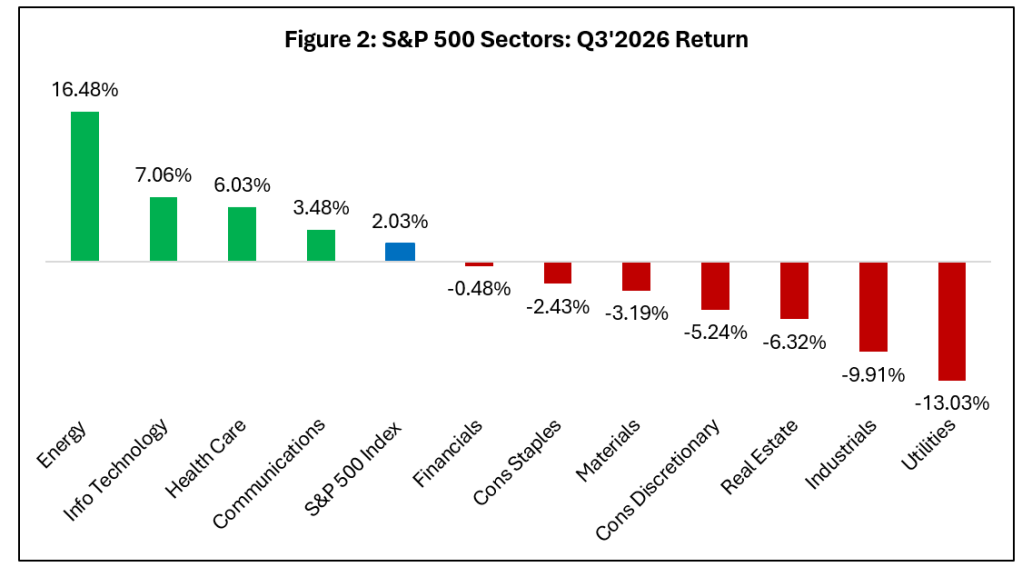
The Energy sector staged a striking rebound in the third quarter of 2026, moving from the weakest performer in the second quarter to the clear leader by quarter‑end. Over the three months to 30 September, the S&P 500 Energy index rose 16.48%, outpacing all other sectors by a wide margin.
This turnaround was driven by a sharp escalation in Middle East tensions, which pushed oil prices significantly higher. During the quarter, the U.S. – Iran conflict expanded into two critical maritime chokepoints at once – the Strait of Hormuz and the Bab al‑Mandab/Red Sea corridor. Iran kept Hormuz closed for the majority of the time period over July to September 2026, stating it would remain shut until its conditions were met and U.S. commitments implemented. At the same time, Iran‑backed Houthi forces advanced rapidly along Yemen’s Red Sea coast, seizing several strategic islands that sit directly in the main shipping lane through Bab al‑Mandab.
With Hormuz closed and the Houthis tightening their grip around Bab al‑Mandab, the region faced simultaneous threats to both the primary and alternative oil export routes. The conflict also widened geographically, shifting from direct U.S.–Iran strikes to proxy‑led offensives in Yemen and intensifying pressure on Saudi Arabia, making the situation more complex and harder to contain. As a result, Brent crude rose about 42% in Q3’2026 to roughly USD103.5/bbl, while WTI climbed around 30% to about USD90.4/bbl, reflecting market fears of supply disruptions tied to the Iran conflict.
The Information Technology sector finished a distant second, up 7.06% in the quarter, a marked slowdown from the 31.60% gain recorded in Q2’2026. The moderation reflected growing caution around the AI trade: several leading AI companies signalled a slowdown in model development and called for greater industry oversight, prompting investors to reassess how quickly AI‑related capital expenditure can translate into sustainable profits.
Source: Bloomberg
U.S. Treasuries
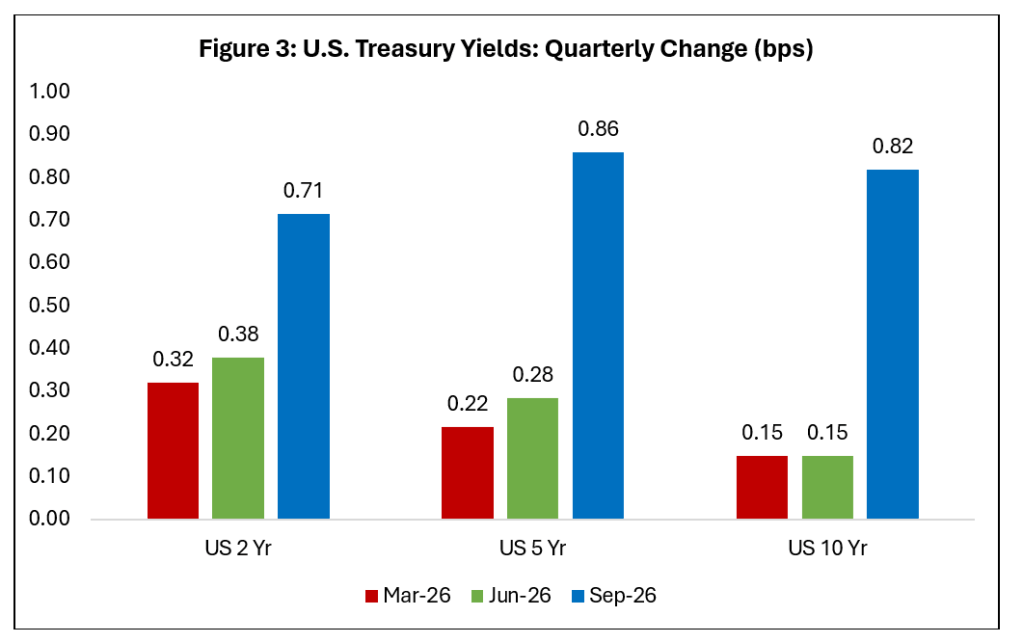
During the third quarter of 2026, the U.S. Treasury yield curve shifted noticeably higher, as yields increased across short, medium and longer-term maturities. The relatively broad-based rise reflected growing concerns about inflation and expectations that interest rates would remain higher for longer, particularly following the renewed oil-price shock and the Fed more hawkish policy stance.
By the end of September 2026, Treasury yields had climbed to multi-year highs across several key maturities. The 2-year Treasury yield increased by approximately 0.715 basis points during the quarter, while the 5-year and 10-year yields rose by 0.859 and 0.82 basis points, respectively.
Local Market Review
The positive momentum seen in the Trinidad and Tobago equity market during the second quarter of 2026 continued into the third quarter, with all three major market indices ending the period in positive territory. However, performance varied considerably across the indices.
The Cross Listed Index led the market, advancing 9.10% during the quarter, a notable acceleration from its 3.53% gain in Q2’2026. The TT Composite Index followed with a more moderate increase of 3.05%, although this represented a slowdown from the 5.92% gain recorded in the previous quarter. Meanwhile, the All T&T Index posted the smallest increase, rising 1.07% compared with a much stronger 6.73% gain in Q2’2026.
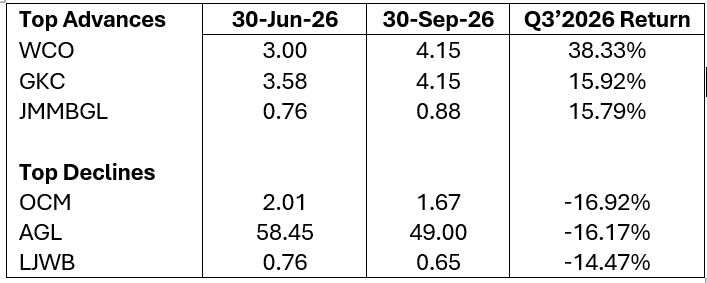
Market participation remained relatively broad, with 17 listed companies recording share price gains, unchanged from the previous quarter. This suggests that the improvement in investor sentiment extended beyond a small number of stocks. West Indian Tobacco Company Limited (WCO) emerged as the quarter’s strongest performer, with its share price surging 38.33%, from TTD3.00 at the end of June to TTD4.15 at the end of September. GraceKennedy Limited (GKC) followed with a gain of 15.92%, while JMMB Group Limited (JMMBGL) advanced 15.79%.
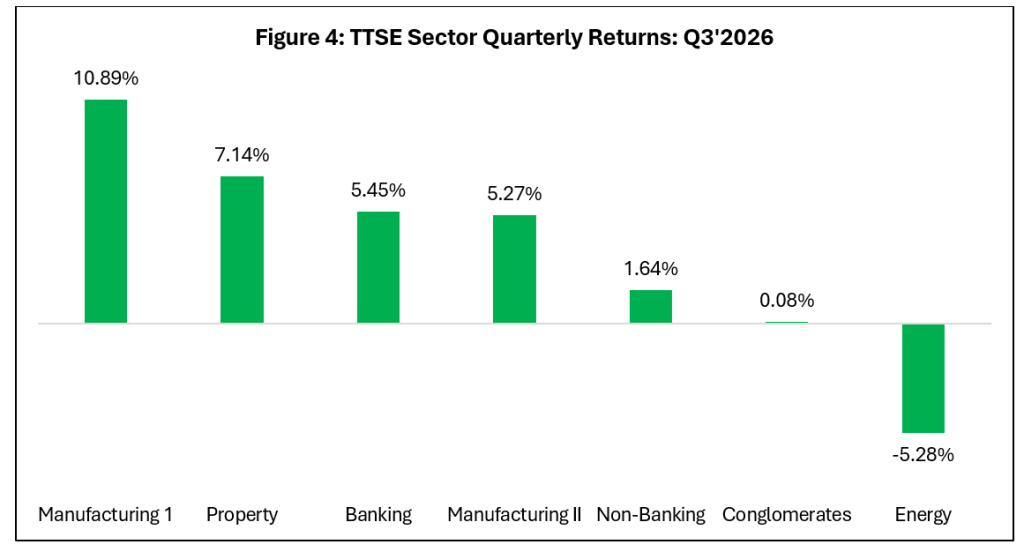
At the sector level, the Manufacturing I sector recorded the strongest quarterly performance, advancing 10.89%, followed by the Property sector, which gained 7.14%. In contrast, the Energy sector, which had been the strongest-performing sector in Q2’2026, reversed course and became the only sector to record a decline during the third quarter, falling 5.28%.
Table 1: Local Stock Indices Performance
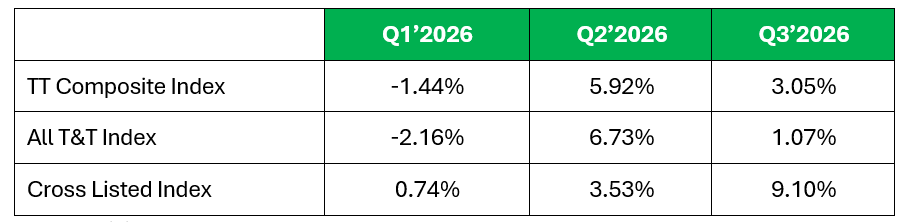
Table 2: Top Advances and Declines: Q3’2026
Equity Markets Outlook
Global equity markets are expected to remain subdued and volatile during the final quarter of 2026, as investors navigate a challenging combination of heightened geopolitical tensions, elevated energy prices, persistent inflation, restrictive monetary policy and political uncertainty surrounding the U.S. midterm elections.
Geopolitical developments are likely to remain one of the most significant risks to the global outlook. With no clear resolution to the ongoing Middle East conflict in sight, disruptions to major energy transit routes continue to threaten global oil supplies and place upward pressure on energy prices. In response, major economies have turned to emergency oil reserves in an effort to increase supply and ease some of the pressure on global energy markets.
While the release of strategic oil reserves should provide some near-term relief, it does not represent a sustainable solution to prolonged supply disruptions. Emergency reserves are finite and cannot indefinitely replace normal production and transportation flows. Consequently, energy prices are likely to remain particularly sensitive to developments in the Middle East, leaving the global economy vulnerable to renewed price spikes.
Political developments will also take centre stage during the quarter, with the U.S. midterm elections scheduled for November 3, 2026. All 435 seats in the House of Representatives and roughly one-third of the Senate are being contested, meaning the elections will determine the balance of power in Congress for the remaining two years of President Donald Trump’s term.
For financial markets, the importance of the midterms extends beyond the election itself. The composition of Congress will influence the administration’s ability to advance its legislative agenda and could shape the direction of fiscal, trade and energy policy. Investors are therefore likely to pay close attention to the potential implications for government spending, taxation, tariffs and regulation.
Despite these headwinds, continued investment in artificial intelligence infrastructure should remain an important source of support for selected areas of the equity market. Significant AI-related capital expenditure has been a major contributor to earnings expectations, particularly within the technology sector.
DISCLAIMER
First Citizens Bank Limited (hereinafter “the Bank”) has prepared this report which is provided for informational purposes only and without any obligation, whether contractual or otherwise. The content of the report is subject to change without any prior notice. All opinions and estimates in the report constitute the author’s own judgment as at the date of the report. All information contained in the report that has been obtained or arrived at from sources which the Bank believes to be reliable in good faith but the Bank disclaims any warranty, express or implied, as to the accuracy, timeliness, completeness of the information given or the assessments made in the report and opinions expressed in the report may change without notice. The Bank disclaims any and all warranties, express or implied, including without limitation warranties of satisfactory quality and fitness for a particular purpose with respect to the information contained in the report. This report does not constitute nor is it intended as a solicitation, an offer, a recommendation to buy, hold, or sell any securities, products, service, investment, or a recommendation to participate in any particular trading scheme discussed herein. The securities discussed in this report may not be suitable to all investors, therefore Investors wishing to purchase any of the securities mentioned should consult an investment adviser. The information in this report is not intended, in part or in whole, as financial advice. The information in this report shall not be used as part of any prospectus., offering memorandum or other disclosure ascribable to any issuer of securities. The use of the information in this report for the purpose of or with the effect of incorporating any such information into any disclosure intended for any investor or potential investor is not authorized.
DISCLOSURE
We, First Citizens Bank Limited hereby state that (1) the views expressed in this Research report reflect our personal view about any or all of the subject securities or issuers referred to in this Research report, (2) we are a beneficial owner of securities of the issuer (3) no part of our compensation was, is or will be directly or indirectly related to the specific recommendations or views expressed in this Research report (4) we have acted as underwriter in the distribution of securities referred to in this Research report in the three years immediately preceding and (5) we do have a direct or indirect financial or other interest in the subject securities or issuers referred to in this Research report.