Financing Growth: Debt, Equity or Cash
Commentary
In a previous article, “Two Paths to Growth – Building Value from Within or through Acquisition” we explored the two main ways companies can choose to expand: growing organically by investing in their existing operations or pursuing inorganic growth through acquisitions and other strategic transactions. While growth can create significant value, it is rarely free. Whether a company is building a new factory, entering a new market, developing a product or acquiring another business, expansion generally requires capital. An important question for investors is therefore not only how quickly a company is growing, but how that growth is being financed.
Growth requires capital as expanding existing operations or acquiring new opportunities must ultimately be funded. Companies generally have three main sources of financing available: cash generated internally, debt or equity. In practice, many companies use a combination of all three.
For investors, understanding how growth is financed is therefore just as important as understanding the growth opportunity itself. A promising expansion can either strengthen a company when financed prudently, but the same opportunity can also weaken shareholder value.
How Is Growth Financed?
Cash-Funded Growth
A cash-funded expansion occurs when a company finances its growth using cash already available within the business, rather than raising new debt or issuing additional shares. This funding generally comes from two main sources: cash generated from operations and existing cash reserves.
Operating cash flow represents the cash generated through the company’s normal day-to-day activities. After meeting operating expenses, taxes, interest and other obligations, a company may retain a portion of this cash to reinvest in the business and support future growth. Existing cash balances, on the other hand, represent cash and other highly liquid resources accumulated on the company’s balance sheet over time. A company with substantial cash reserves may choose to deploy some of these funds towards expansion rather than leave the capital idle or seek external financing.
Cash-funded expansion offers several important advantages. Most notably, it allows a company to pursue growth without taking on additional interest or principal repayment obligations. When an expansion is financed through debt, a portion of the earnings and cash generated by the investment must be directed towards servicing the additional borrowing. A cash-funded investment carries no such contractual obligation. As a result, a greater proportion of the future earnings and cash flows generated by the expansion can remain within the business, supporting profitability, further reinvestment and, over time, potential distributions to shareholders.
Financing growth with cash can also help preserve the company’s financial strength and flexibility. By avoiding additional borrowing, the company limits its fixed financial obligations and maintains healthier leverage and debt-service levels. This can make the business better positioned to withstand unexpected economic or financial pressures while preserving its borrowing capacity for future needs. As a result, management retains greater flexibility to raise debt should new investment opportunities arise or additional funding become necessary. This advantage can be particularly valuable during periods of elevated interest rates, when taking on new debt may be considerably more expensive.
However, using cash does not mean that the financing is without cost. Although there is no explicit interest expense, cash carries an opportunity cost because every dollar committed to expansion is a dollar that can no longer be used elsewhere. The company sacrifices alternative uses of those funds, which could include repaying debt, making another investment, repurchasing shares, maintaining a larger liquidity reserve or returning capital to shareholders through dividends.
The potential impact on dividends is particularly relevant for income-focused investors. If a company directs a significant portion of its available cash towards expansion, less cash may be available for shareholder distributions in the short to medium term. Management may therefore choose to reduce the dividend, maintain it rather than increase it, or temporarily suspend distributions to preserve cash to fund the investment. For shareholders who rely on dividends as an important component of their investment return, this can reduce the income portion of total shareholder return, at least temporarily.
Example: Total Stock Return
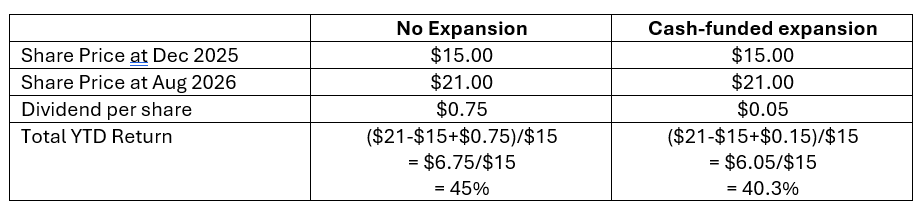
Consider Company A, whose share price increased from $15.00 in December 2025 to $21.00 in August 2026 and paid a dividend of $0.75 per share.
A shareholder total return would be: 45%.
Suppose Company A instead directed a significant portion of its available cash towards funding an expansion, resulting in the dividend being reduced from $0.75 to $0.05 per share.
The lower dividend would reduce the income received by shareholders and bring the total return to approximately 40.3%, compared with 45% had the higher dividend been maintained.
Table 1: Total Return Example
Debt-Financed Growth
Unlike cash-funded expansion, debt-financed growth allows a company to preserve its existing cash by borrowing the funds needed to pursue expansion. Companies primarily raise debt through bank loans and through the issuance of bonds.
A bank loan, often structured as a term loan, is an agreement between a company and one or more banks to borrow a specified amount for a defined period. The company receives the funds and repays the loan according to an agreed schedule, together with interest.
Bonds provide another avenue for raising debt, particularly for larger companies seeking access to capital markets. Instead of borrowing directly from a bank, the company issues debt securities to investors, which may include pension funds, insurance companies, asset managers and other institutional investors. In return, the company generally makes periodic interest, or coupon, payments and repays the principal when the bond matures.
One of the main advantages of debt financing is that it allows companies to pursue growth opportunities beyond what their existing cash resources would otherwise permit. Consider a company that identifies an attractive $500 million acquisition but has only $200 million of excess cash available. Rather than waiting several years to accumulate the remaining funds, the company could borrow some or all of the difference and complete the acquisition immediately. Debt can therefore accelerate expansion and allow a company to take advantage of opportunities that might otherwise be lost to competitors or become more expensive over time.
The benefits of debt, however, come with greater financial risk. Unlike dividends, which can generally be reduced or suspended at management’s discretion, interest and principal payments represent contractual obligations. These payments must be made regardless of how the underlying investment performs. If an acquisition fails to deliver the expected earnings, an expansion encounters difficulties or an economic downturn causes revenues and cash flows to decline, the company must still service its debt.
Higher debt levels can also place pressure on a company’s profitability and its credit profile through larger interest expense. Furthermore, if debt increases significantly without a corresponding improvement in earnings and cash flow, leverage ratios may deteriorate while the company’s ability to cover its interest obligations weakens. Credit-rating agencies may consequently reassess the company’s creditworthiness and may lead to a downgrade in their credit rating. A downgrade can have broader implications, including higher borrowing costs, reduced access to capital markets and more expensive refinancing when existing debt matures.
Example: How Interest Expense Affects Net Profit
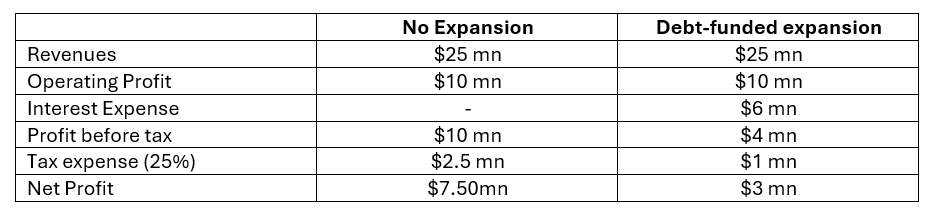
Assume Company A generates operating profit of $10 million before interest and taxes. The company is considering borrowing $100 million at an annual interest rate of 6% to finance its expansion.
The new debt would generate annual interest expense of:
$100 million × 6% = $6 million
Assuming a 25% corporate tax rate, the impact on profit would be sizeable. In this simplified example, the additional interest expense causes net profit to decline from $7.50 million to $3 million, representing a 60% reduction.
Table 2: Net Profit Example
Equity Capital
The third major avenue available to companies is equity-financed growth. Rather than using accumulated cash or borrowing money, a company can raise capital by issuing new shares to investors and using the proceeds to finance its expansion.
For a publicly listed company, equity can be raised in several ways, including the issuance of additional ordinary shares through a public offering, private placement or rights issue. In an acquisition, a company may also use its own shares as a form of currency, issuing shares directly to the shareholders of the company being acquired instead of paying the full purchase price in cash.
One of the main advantages of equity financing is that, unlike debt, the capital raised does not have to be repaid at a specified maturity date and does not carry mandatory interest payments. This can make equity particularly attractive for companies that already have significant debt or whose future cash flows may be uncertain. By raising equity instead of borrowing, the company can pursue growth without placing additional pressure on its debt-service obligations.
Equity financing can also help preserve the company’s cash reserves and borrowing capacity. Since the company does not have to commit a large portion of its existing cash to the investment or assume additional debt, it may retain greater liquidity to meet operating requirements, withstand unexpected financial pressures or pursue other opportunities. A stronger equity base can also reduce financial leverage and potentially provide greater capacity to borrow in the future.
However, this financial flexibility comes with an important trade-off for existing shareholders: dilution. When a company issues additional shares, the total number of shares outstanding increases. Unless existing shareholders purchase a proportionate amount of the new shares, their percentage ownership of the company declines
Example: How Share Dilution Works
Assume Company A has 1 million shares outstanding, and an investor owns 100,000 shares. The investor therefore owns:
100,000 ÷ 1,000,000 = 10% of Company A
Company A now wants to finance an acquisition by issuing 300,000 new shares to the shareholders of the company it is acquiring.
After the transaction, Company A will have:
1,000,000 existing shares + 300,000 new shares = 1,300,000 outstanding shares.
The original investor still owns 100,000 shares, but their ownership falls to:
100,000 ÷ 1,300,000 = 7.69%
Therefore, although the investor has not sold any shares, their ownership has declined from 10% to 7.69%. The investor has therefore experienced ownership dilution. Their 100,000 shares now represent a smaller proportion of the company.
Table 3: Dilution Example

Debt, Cash or Equity – Which is Better?
There is no single financing method that is appropriate for every company or every growth opportunity. Cash, debt and equity each carry different benefits and costs, and the appropriate choice depends on the company’s existing financial position, the size and risk of the investment, prevailing market conditions and management’s expectations for future earnings and cash flow.
The decision, however, does not always have to be cash versus debt versus equity. Companies frequently use a combination of all three to balance the competing objectives of preserving liquidity, controlling leverage and limiting shareholder dilution.
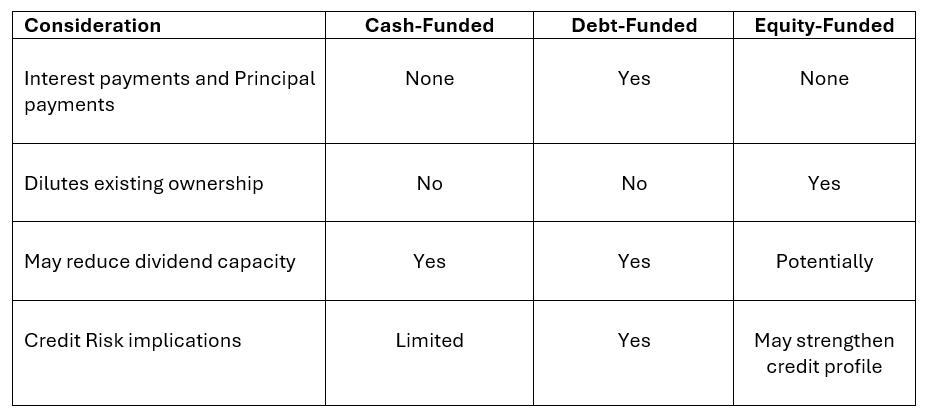
Table 4: Cash, Debt and Equity-Funded Growth Comparison
What Should Investors look for?
Investors should look beyond the headline announcement that a company is expanding and examine how that growth is being paid for. Cash may protect shareholders from dilution and additional leverage but reduce financial reserves. Debt may enhance returns while preserving ownership but increase financial risk. Equity may protect the balance sheet but dilute existing shareholders.
Ultimately, there is no single financing approach that is suitable for every company or every growth opportunity. The most appropriate structure is one that allows a business to pursue meaningful expansion while maintaining a healthy balance between financial strength, liquidity and shareholder interests. Whether growth is funded through cash, debt, equity or a combination of the three, the true measure of success lies not simply in how much larger the company becomes, but in whether that growth creates lasting value. The additional earnings and cash flows generated should be sufficient to justify the capital invested and the risks undertaken. For investors, the key question is therefore not only “Is the company growing?” but “Is it financing that growth in a way that strengthens the business and creates sustainable value for shareholders over the long term?”
DISCLAIMER
First Citizens Bank Limited (hereinafter “the Bank”) has prepared this report which is provided for informational purposes only and without any obligation, whether contractual or otherwise. The content of the report is subject to change without any prior notice. All opinions and estimates in the report constitute the author’s own judgment as at the date of the report. All information contained in the report that has been obtained or arrived at from sources which the Bank believes to be reliable in good faith but the Bank disclaims any warranty, express or implied, as to the accuracy, timeliness, completeness of the information given or the assessments made in the report and opinions expressed in the report may change without notice. The Bank disclaims any and all warranties, express or implied, including without limitation warranties of satisfactory quality and fitness for a particular purpose with respect to the information contained in the report. This report does not constitute nor is it intended as a solicitation, an offer, a recommendation to buy, hold, or sell any securities, products, service, investment, or a recommendation to participate in any particular trading scheme discussed herein. The securities discussed in this report may not be suitable to all investors, therefore Investors wishing to purchase any of the securities mentioned should consult an investment adviser. The information in this report is not intended, in part or in whole, as financial advice. The information in this report shall not be used as part of any prospectus, offering memorandum or other disclosure ascribable to any issuer of securities. The use of the information in this report for the purpose of or with the effect of incorporating any such information into any disclosure intended for any investor or potential investor is not authorized.
DISCLOSURE
We, First Citizens Bank Limited hereby state that (1) the views expressed in this Research report reflect our personal view about any or all of the subject securities or issuers referred to in this Research report, (2) we are a beneficial owner of securities of the issuer (3) no part of our compensation was, is or will be directly or indirectly related to the specific recommendations or views expressed in this Research report (4) we have acted as underwriter in the distribution of securities referred to in this Research report in the three years immediately preceding and (5) we do have a direct or indirect financial or other interest in the subject securities or issuers referred to in this Research report.