AI’s Growing Energy Appetite: Opportunities and Risks for Investors
Commentary

Artificial intelligence (AI) is rapidly transforming the global economy, reshaping business operations, enhancing productivity and creating new investment opportunities. As technology companies accelerate investment in advanced computing systems and data centres to support the growing adoption of AI, an increasingly important challenge is emerging: the substantial amount of electricity required to power this technological revolution. The rapid expansion of AI infrastructure is placing growing pressure on electricity generation and transmission networks, raising concerns about whether energy supply can keep pace with demand.
While the AI investment boom has largely focused on technology companies and semiconductor manufacturers, its growing electricity requirements are creating opportunities across the energy sector, particularly for electric utilities, power producers and electrical infrastructure providers. However, these developments also introduce financial risks, as rising energy costs, substantial capital expenditure and infrastructure constraints could place pressure on corporate profitability and investment returns.
For investors, the rapid expansion of artificial intelligence presents both compelling investment opportunities and emerging risks that warrant careful consideration. Beyond identifying industries poised to benefit from the AI revolution, the greater challenge lies in distinguishing companies capable of converting accelerating demand into sustainable earnings growth, stronger cash flows and long-term shareholder value.
As AI adoption gathers momentum, access to reliable and competitively priced electricity is likely to become an increasingly important determinant of corporate profitability, competitive positioning and investment returns. Consequently, understanding the evolving relationship between AI-driven electricity demand, energy infrastructure constraints and corporate cost structures will be essential in identifying the companies best positioned to capitalize on this technological transformation, while recognizing those potentially vulnerable to rising energy costs and operational disruptions.
AI’s Growing Electricity Demand
Artificial intelligence (AI) requires substantial amounts of electricity to power the advanced computing systems that process vast quantities of data, perform complex calculations and support increasingly sophisticated applications.
Training AI models involves thousands of high-performance processors operating simultaneously, while the growing use of AI-powered services creates continuous demand for computing capacity. These systems are housed in large data centers that consume considerable electricity not only to operate servers but also to power cooling systems that prevent equipment from overheating. As AI becomes more widely integrated into business operations and everyday activities, the expansion of data-center infrastructure is expected to drive a significant increase in global electricity consumption.
The scale of this growing demand is already becoming evident. According to the International Energy Agency’s (IEA) April 2026 report, Key Questions on Energy and AI, global data-centre electricity consumption increased by 17% in 2025 to approximately 485 terawatt-hours (TWh), with electricity consumption from AI-focused data centers rising by an even faster 50%. The IEA projects that global data-center electricity demand will nearly double to approximately 950 TWh by 2030, accounting for around 3% of global electricity consumption. Meanwhile, electricity consumption from AI-focused facilities is projected to triple over the same period. These projections highlight the growing importance of electricity to the continued expansion of AI and the substantial additional demand that energy providers may be required to accommodate.
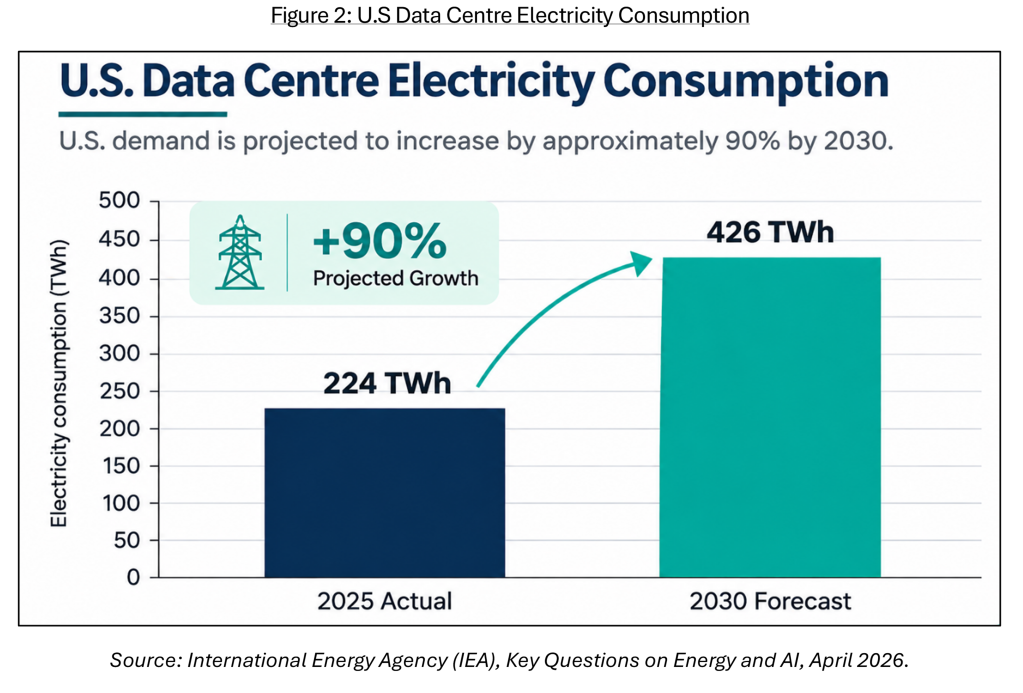
For the U.S., the IEA estimates that data center electricity consumption reached approximately 224 TWh in 2025 and projects that it could rise to 426 TWh by 2030 under its Base Case. This represents an increase of approximately 90%, placing additional pressure on the country’s electricity infrastructure.
Figure 1: Global Data Centre Electricity Demand (2025–2030)

Infrastructure Constraints
The rapid expansion of artificial intelligence (AI) is placing growing pressure on electricity infrastructure, raising concerns about whether energy supply can keep pace with demand. One of the major challenges is the ageing electricity infrastructure in several developed economies, particularly the U.S., where power grids require significant upgrades to accommodate rising electricity consumption. While technology companies are investing heavily in new data centres, the expansion of electricity networks has been comparatively slow.
Similar pressures are emerging in major technology hubs across Europe and Asia, including Ireland, the Netherlands and Singapore, where limited grid capacity, land availability and environmental considerations have constrained further data-centre expansion
Another major challenge is the ability of electricity producers to increase generation capacity quickly enough to meet growing demand. Unlike electricity consumption, which has historically grown at a relatively modest pace in many developed economies, the rapid expansion of AI-powered data centers is creating substantial additional demand within a short period. However, constructing new power plants can take several years, given the time required for planning, regulatory approvals and construction.
Investment Opportunities and Risks
AI’s expanding electricity needs are creating a compelling investment opportunity beyond traditional technology companies. As data center construction accelerates globally, the beneficiaries are likely to include utilities, power producers, electrical infrastructure providers, and select fixed-income issuers positioned to support the buildout of the energy ecosystem required to power AI.
At the equity level, utilities operating in regions experiencing significant data center development stand to benefit from higher electricity demand, increased power sales, and investment in generation and transmission capacity. Companies involved in transformers, grid equipment, and electrical infrastructure may also see sustained demand as electricity networks are modernized to accommodate AI-driven power consumption. While these trends support long-term growth, investors should remain mindful that substantial capital expenditure requirements could increase leverage and place pressure on profitability.
The energy sector is similarly positioned to benefit as data centers require reliable, continuous power supplies. According to the International Energy Agency, coal currently provides approximately 30% of global data center electricity consumption, followed by renewable energy at 27% and natural gas at 26%. As AI adoption expands, companies involved in power generation, transmission, and energy delivery are likely to play an increasingly important role in meeting rising electricity demand.
For fixed-income investors, this transformation could create a growing pipeline of opportunities as utilities, energy infrastructure companies, and technology firms access debt markets to fund new power generation assets, transmission networks, and data center investments. However, not all issuers will benefit equally. The most attractive opportunities are likely to be those with strong cash flow generation, prudent leverage profiles, and demonstrated capacity to fund growth while maintaining balance sheet strength. As a result, credit selection will be critical, with preference given to issuers that can capture AI-related growth without compromising their financial resilience.
The bottom line is while AI is often viewed through a technology lens, investors may find some of the most durable opportunities in the industries providing the power and infrastructure that enable its growth. Diversified exposure across utilities, energy infrastructure, and high-quality credit may offer a more balanced approach to participating in this long-term structural trend.
Broader Market Implications
The growing electricity demand associated with AI could have broader implications for inflation and economic growth, particularly in regions where electricity supply struggles to keep pace with consumption. As data-center development accelerates, increased competition for limited electricity supplies could place upward pressure on energy prices, raising operating costs for businesses and increasing electricity bills for households. Higher electricity expenses could, in turn, reduce household purchasing power and constrain consumer spending, particularly among lower-income households, where energy costs account for a larger share of disposable income. According to Goldman Sachs, rising electricity prices could reduce U.S. consumer spending growth by approximately 0.20% over 2026–2027, while lowering GDP growth by around 0.10%.
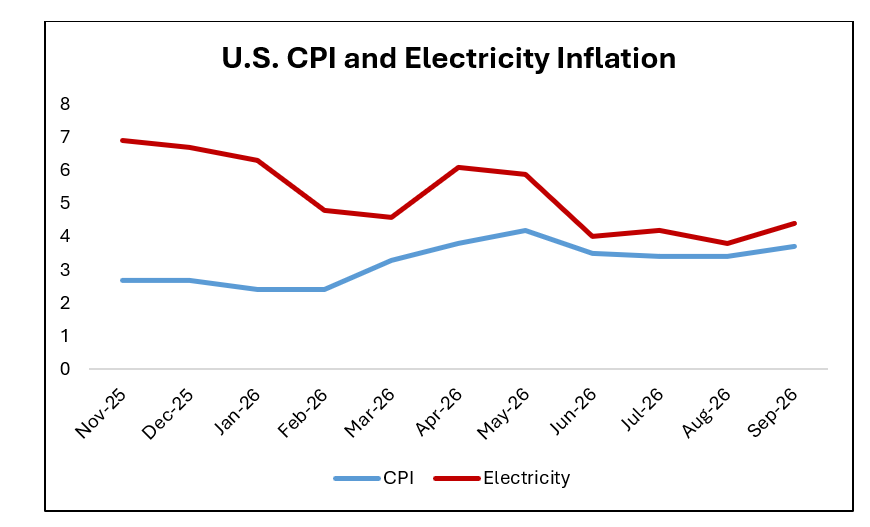
These concerns are particularly relevant in the U.S., where electricity price increases have consistently outpaced headline Consumer Price Index (CPI) inflation since November 2025. Looking ahead, the continued expansion of AI-powered data centers is expected to sustain strong electricity demand, potentially adding to existing inflationary pressures.
These pressures could be intensified by constraints on electricity supply, as expanding generation capacity requires considerable time and investment. Lengthy regulatory approval processes, shortages of specialized equipment and limited availability of skilled labour could further delay the development of new power infrastructure. Consequently, the combination of rapidly growing demand and slower supply expansion could drive electricity prices higher in regional wholesale markets, where utilities and other market participants purchase power before distributing it to households and businesses.
Persistently higher electricity prices could also have important implications for monetary policy and financial markets. To the extent that rising energy costs contribute to sustained inflationary pressures, central banks may adopt a more cautious approach to monetary policy easing, potentially keeping interest rates elevated for longer.
For fixed-income investors, persistent inflation and higher inflation expectations could place upward pressure on government bond yields, reducing the market value of existing fixed-rate securities while increasing borrowing costs for businesses and governments. However, the broader economic impact will depend on whether electricity price increases remain concentrated in regions experiencing rapid data-center expansion or become sufficiently widespread to influence national inflation trends.
Overall, the outlook for AI-related investments remains favourable over the long term, although growing energy requirements introduce additional risks that warrant careful consideration. The most attractive opportunities may extend beyond the technology companies leading the AI revolution to businesses providing the electricity and infrastructure needed to sustain its growth. Ultimately, investors should focus not merely on identifying sectors benefiting from rising AI-related demand, but on selecting companies with the financial strength, operational efficiency and earnings potential to translate this structural growth into attractive risk-adjusted returns.
Figure 3: U.S CPI and Electricity Inflation
DISCLAIMER
First Citizens Bank Limited (hereinafter “the Bank”) has prepared this report which is provided for informational purposes only and without any obligation, whether contractual or otherwise. The content of the report is subject to change without any prior notice. All opinions and estimates in the report constitute the author’s own judgment as at the date of the report. All information contained in the report that has been obtained or arrived at from sources which the Bank believes to be reliable in good faith but the Bank disclaims any warranty, express or implied, as to the accuracy, timeliness, completeness of the information given or the assessments made in the report and opinions expressed in the report may change without notice. The Bank disclaims any and all warranties, express or implied, including without limitation warranties of satisfactory quality and fitness for a particular purpose with respect to the information contained in the report. This report does not constitute nor is it intended as a solicitation, an offer, a recommendation to buy, hold, or sell any securities, products, service, investment, or a recommendation to participate in any particular trading scheme discussed herein. The securities discussed in this report may not be suitable to all investors, therefore Investors wishing to purchase any of the securities mentioned should consult an investment adviser. The information in this report is not intended, in part or in whole, as financial advice. The information in this report shall not be used as part of any prospectus, offering memorandum or other disclosure ascribable to any issuer of securities. The use of the information in this report for the purpose of or with the effect of incorporating any such information into any disclosure intended for any investor or potential investor is not authorized.
DISCLOSURE
We, First Citizens Bank Limited hereby state that (1) the views expressed in this Research report reflect our personal view about any or all of the subject securities or issuers referred to in this Research report, (2) we are a beneficial owner of securities of the issuer (3) no part of our compensation was, is or will be directly or indirectly related to the specific recommendations or views expressed in this Research report (4) we have acted as underwriter in the distribution of securities referred to in this Research report in the three years immediately preceding and (5) we do have a direct or indirect financial or other interest in the subject securities or issuers referred to in this Research report.