Rethinking Trinidad and Tobago’s Labour Market
Commentary

From an economic perspective, this situation is somewhat puzzling. Following the 2006-2014 energy boom years, Trinidad and Tobago has experienced a prolonged economic slowdown lasting over a decade, including a sharp contraction during the pandemic. Nevertheless, unemployment did not rise in a way that fully matched the weakness in output. Based on data from the Central Bank of Trinidad and Tobago (CBTT), average unemployment was recorded at 3.3% in 2015, peaked at 5.7% in 2020, and stood at 4.5% for 2025. Most recent quarterly data from the Central Statistical Office (CSO) reported an unemployment rate of 4.3% in Q4’2025.
Taken at face value, this looks like an unusually strong labour market. But the unemployment rate alone does not tell the whole story. A low unemployment rate can mean that most people who want work are finding it. It can also mean that fewer people are actively participating in the labour market.
Defining Labour Market Metrics
Definitionally, the unemployment rate is calculated as the number of unemployed people divided by the size of the labour force. The labour force includes two categories of people: those who are employed and those who are unemployed but actively seeking work. Crucially, it does not include people outside the labour force, such as full-time students, retirees, people engaged in home duties, discouraged workers who are no longer searching, or others who are not economically active.
This distinction is important. If a worker loses a job and actively searches for work, that person is counted as unemployed. But if the same person stops looking, retires early, returns to school, takes on home duties, or moves into informal or irregular work that is not captured in the same way, the unemployment rate may not rise and in some instances can even fall.
This is why labour force participation matters. The labour force participation rate (LFPR) measures the share of the working-age population that is either employed or actively seeking employment. When participation declines, the unemployment rate may understate labour market weakness because a smaller share of the population is being counted in the denominator.
What T&T’s Unemployment Data Shows
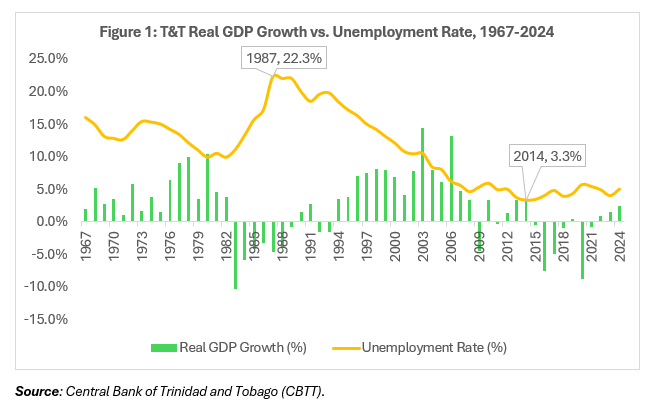
From a historical perspective, Trinidad and Tobago’s unemployment rate has generally tracked with the state of the economy since Independence, moving in a countercyclical fashion. As the economy improves and real GDP growth increases, more job opportunities become available leading to a fall in unemployment, and conversely when the economy declines, opportunities dry up and unemployment rises. This pattern can clearly be seen in the 1980s and 1990s (see Figure 1).
During the 1980s, Trinidad and Tobago’s economic fortunes reversed drastically with the decline in oil prices, and the economy recorded negative real growth in every year between 1983 and 1989, consistent declines in oil production, and a sharp fall in export earnings. Accordingly, unemployment rose sharply over this period, peaking at 22.3% in 1987. As structural reforms led to an economic recovery in the 1990s, eventually facilitating the natural gas-driven boom of the 2000s, real GDP growth averaged well in excess of 3% per year, while unemployment enjoyed a long and secular decline to a low of 3.3% in 2014.
Labour Force Participation Tells a Different Story
Since 2014 though, the pattern between growth and unemployment has become more ambiguous. The economy recorded several years of real GDP contraction, with -7.5% in 2016, -4.9% in 2017 and -8.8% in 2020, yet unemployment remained comparatively stable throughout the period, rising only 2.4 percentage points from the all-time low of 3.3% in 2014 to 5.7% in the pandemic-affected year of 2020. Clearly there was a breakdown in the relationship between growth and unemployment in the most recent cycle of economic contraction in Trinidad and Tobago. Enter the LFPR.
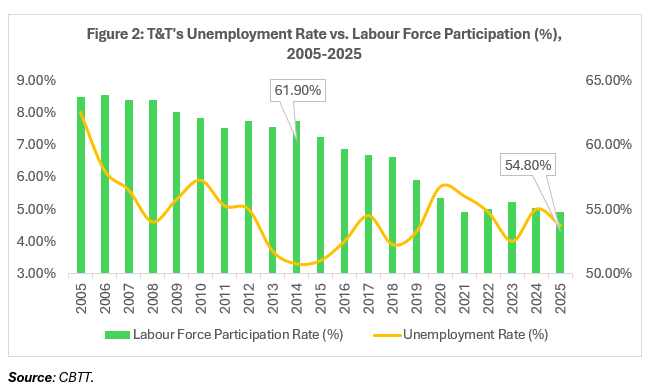
Zooming in to Figure 2 to observe the post-2014 economic decline, we see a labour market that is relatively tight by the headline unemployment measure, but one in which a large and growing number of people remain outside the labour force. Since the end of the commodity boom, unemployment has risen slightly but remained fairly stable, while the LFPR has declined substantially, from 61.9% at the start of the contractionary period in 2014 to the most recent annual average figure of 54.8% in 2025.
In absolute terms, the CSO estimated that the non-institutional population aged 15 and over was about 1.08 million people in Q4’2025. Of this, about 595,700 were in the labour force, 569,900 had jobs, and 25,700 were unemployed. However, a large group — approximately 485,300 people — was classified as not being in the labour force. The last quoted figure is quite significant. It means that the number of people, of working age, outside the labour force was nearly twenty times as large as the number of people officially unemployed.
This helps explain the apparent contradiction between low unemployment and weak economic performance. The economy did not necessarily absorb labour in a way that fully offset the slowdown. Rather, part of the adjustment may have occurred through reduced participation. Individuals may have left the labour force because of retirement, discouragement, care responsibilities, illness, skills mismatch, or a lack of attractive job opportunities.
Trinidad and Tobago’s LFPR has been on the low side relative to its own history. CBTT data shows that the average LFPR for Trinidad and Tobago over the period 1991 to 2025 stood at 60%, with a high of 64.5% in Q4’2004 and a low of 53.4% in Q3’2021. Against that history, a participation rate of around 54.8% suggests that the labour market has not fully returned to earlier levels of engagement.
Many of the 485,300 working age individuals outside of the labour force would have legitimate reasons for not seeking employment, such as early retirement, study, disability, family care, etc. The number outside of the labour force is also likely to count many participating in the informal economy, defined by the International Monetary Fund (IMF) as “activities that have market value and would add to tax revenue and GDP if they were recorded.” The informal economy by definition is very broad and includes unregistered service providers, with output estimated between 26%-33% of Trinidad and Tobago’s GDP according to a 2017 Inter-American Development Bank (IDB) study.
The International Labour Organization (ILO) identifies food and beverage, construction, transport and auto repairs as industries with a high concentration of informal economic activity in Trinidad and Tobago. Unfortunately, the informal sector also includes illicit activities such as money laundering, narcotics, gun smuggling and prostitution, and the IDB study flags these as significant contributors to the informal economy in Trinidad and Tobago. Given the rise in criminal activity in this country over the recent past, it is likely that the increase in the number of working-age people outside of the labour force is related to this phenomenon, although granular and regular data collection on this is clearly challenging.
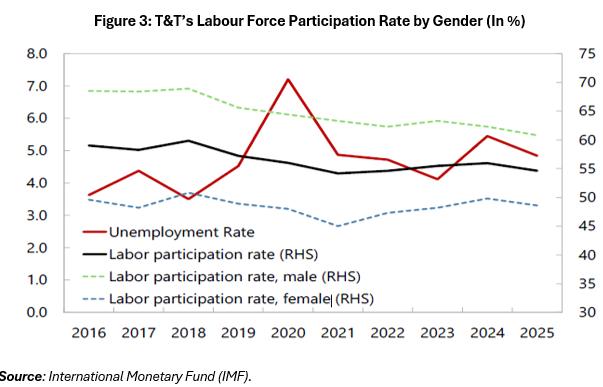
Gender dynamics also matter. In its latest Article IV report on Trinidad and Tobago, the IMF (see Figure 3) reported that the female labour force participation rate declined to 49% in 2025 from 50% in 2024, while the male participation rate fell to 60.1% from 60.9% over the same period. This wide gap between men and women’s participation rates suggests that care responsibilities, job quality, flexibility, transport costs, safety concerns, and sectoral opportunities may all be relevant to understanding participation trends.
This discussion of the declining LFPR is not meant to suggest that all people outside the labour force should be working or seeking work in the formal sector. What it does mean, however, is that in an economy like Trinidad and Tobago’s, unemployment rate alone is too narrow a measure to capture the country’s broader labour market dynamics.
Policy Implications
In Trinidad and Tobago, unemployment rate remains useful and widely understood as a headline macroeconomic indicator. However, to develop a clearer understanding of Trinidad and Tobago’s labour market dynamics, it should be interpreted alongside LFPR, as well as other labour metrics such as employment-to-population ratios, youth unemployment, and measures of job quality.
In particular for Trinidad and Tobago, labour market policy should expand beyond a focus on those currently in employment or actively seeking work, i.e. the labour force, and should increasingly address whether prime-age workers are growing more attached to or more detached from the labour market. Looking at the past twelve years of data, a low unemployment rate may reduce the perceived urgency of labour market reform. But weak participation can signal deeper issues: skills mismatches, insufficient childcare support, inadequate transport, informal work, or limited private-sector dynamism. It can also constrain long-term growth, because fewer people in productive employment means a smaller effective labour input for the economy and a weaker tax base.
The IMF in its Article IV report explicitly addresses the issue of the informal sector in relation to Trinidad and Tobago’s labour force participation, stating in its recommendations that “Decisive steps are needed to raise labour force participation and discourage informality. Informality constrains productivity and facilitates tax evasion.” Improving the ease of doing business, targeting skills training for the long-term unemployed, increasing labour market flexibility and improving support for childcare are examples of interventions that can improve LFPR.
A more holistic labour market picture would place the unemployment rate alongside the LFPR. Doing so would give policymakers, businesses, and the public a clearer picture of whether the labour market is truly strong, or whether low unemployment is masking weaker labour market attachment beneath the surface.
DISCLAIMER
First Citizens Bank Limited (hereinafter “the Bank”) has prepared this report which is provided for informational purposes only and without any obligation, whether contractual or otherwise. The content of the report is subject to change without any prior notice. All opinions and estimates in the report constitute the author’s own judgment as at the date of the report. All information contained in the report that has been obtained or arrived at from sources which the Bank believes to be reliable in good faith but the Bank disclaims any warranty, express or implied, as to the accuracy, timeliness, completeness of the information given or the assessments made in the report and opinions expressed in the report may change without notice. The Bank disclaims any and all warranties, express or implied, including without limitation warranties of satisfactory quality and fitness for a particular purpose with respect to the information contained in the report. This report does not constitute nor is it intended as a solicitation, an offer, a recommendation to buy, hold, or sell any securities, products, service, investment, or a recommendation to participate in any particular trading scheme discussed herein. The securities discussed in this report may not be suitable to all investors, therefore Investors wishing to purchase any of the securities mentioned should consult an investment adviser. The information in this report is not intended, in part or in whole, as financial advice. The information in this report shall not be used as part of any prospectus, offering memorandum or other disclosure ascribable to any issuer of securities. The use of the information in this report for the purpose of or with the effect of incorporating any such information into any disclosure intended for any investor or potential investor is not authorized.
DISCLOSURE
We, First Citizens Bank Limited hereby state that (1) the views expressed in this Research report reflect our personal view about any or all of the subject securities or issuers referred to in this Research report, (2) we are a beneficial owner of securities of the issuer (3) no part of our compensation was, is or will be directly or indirectly related to the specific recommendations or views expressed in this Research report (4) we have acted as underwriter in the distribution of securities referred to in this Research report in the three years immediately preceding and (5) we do have a direct or indirect financial or other interest in the subject securities or issuers referred to in this Research report.