Innovation and Economic Growth
Commentary

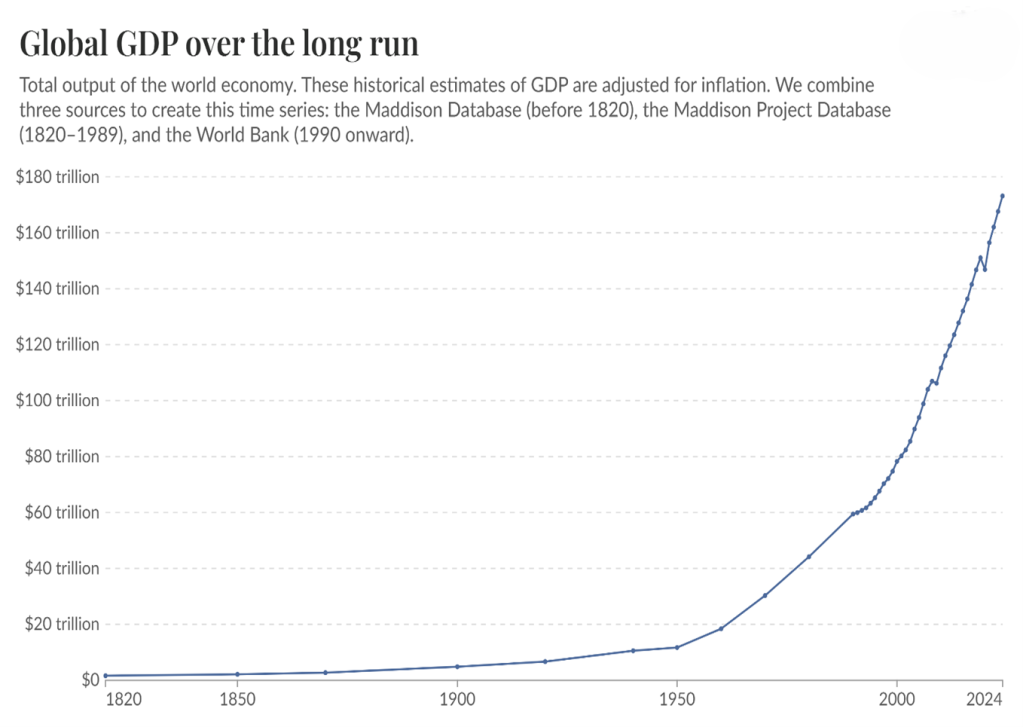
The Industrial Revolution of the 1800s was one of the most important eras in human history, characterized by rapid levels of innovation and growth. It was a major paradigm shift in the global economy, with technological advancements in production replacing a highly labour-intensive process. The Industrial Revolution did this through fostering a culture of continuous innovation — from the spinning jenny and steam engine to advancements in transportation. These technologies not only improved industrial efficiency but also laid the foundation for modern sectors such as energy, manufacturing, and finance. The resulting economic growth fuelled urbanization on a global scale, allowing the global economy to rapidly advance.
Figure 1:
With that said, innovation remains one of the unsung heroes in the global economy; not receiving its fair share of credit until 2025 when three economists, Joel Mokyr, Philippe Aghion and Peter Howitt, won the Nobel prize in economics for their work on the role of innovation in driving economic growth. The prize was split two ways, with Joel Mokyr being awarded for “his description of the mechanisms that enable scientific breakthroughs and practical applications to enhance each other and create a self-generating process, leading to sustained economic growth”; and the other half jointly to Philippe Aghion and Peter Howitt for their 1992 publication where they “constructed a mathematical model of how companies invest in improved production processes and new, better-quality products” and their theory of “creative destruction”.
Nobel Memorial Prize in Economic Sciences 2025
The three economists focused on advanced economies that have, for the most part, enjoyed sustained economic growth since the industrial revolution. Their combined contributions, while using different approaches, ultimately seeks to answer the same questions:
- How was economic growth sustained?
- What conditions allowed it?
- What keeps growth going (or threatens it)?
Joel Mokyr’s contribution was focused on how technological change impacts economic growth since the Industrial Revolution. Interestingly, when assessing technological advancements since ancient China, Greece, and Rome, Mokyr found that technological advancement by itself was historically, not a driver of sustained economic growth; this phenomenon is a symptom of the Industrial revolution over 200 years ago. The failure to sustain economic growth stems from a failure of “macro inventions” (technologies which represent a major shift in available technologies) to generate what is described as “micro inventions” (small incremental improvements in technology which provide a link to the wider economy). This led to Mokyr identifying prerequisite conditions for an economy to reap long-run benefits from technological advancement, that being, skilled thinkers who can use their knowledge to create innovative solutions, as well as a society that is open to change.
Philippe Aghion and Peter Howitt on the other hand, focused on the period following World War 2, and took a micro-level approach. Their mathematical model coined the term “creative destruction”, speaks to new technologies and businesses that replace the old and spark economic growth in return. They also highlight how monopolistic profits (even if temporary) incentivise businesses to push Research and Development (R&D), though monopolistic behaviours may lead to a negative impact on growth. Their creative destruction process can be thought of as a snowballing effect, such that an improvement in a product, or a more efficient way of production can incentivise other market players to make further improvements to gain market share.
T&T Global Innovation standing
In the Global Innovation Index (GII) 2025, published by the World Intellectual Property Organization, Trinidad and Tobago (T&T) ranks 114 out of 139 assessed countries, and 17 out of 21 assessed Latin America and Caribbean countries. Despite the number of countries fluctuating throughout the years (143 countries were ranked in 2014), T&T’s ranking in the GII has been almost consistently worsening since its addition to the index in 2008 where it ranked 61 out of 130 countries.
The GII 2025 highlights a longstanding issue for T&T – a lack of meaningful innovation despite many private-public initiatives. Part of this can be attributed to the Dutch Disease brought about by the expansion of the energy sector, as the last big innovative push was in the mid-1990s when the economy shifted to capitalize on natural gas resources. Since then, it has been relatively stagnant, deepening the reliance on the energy sector for economic growth and leaving the nation vulnerable to external shocks.
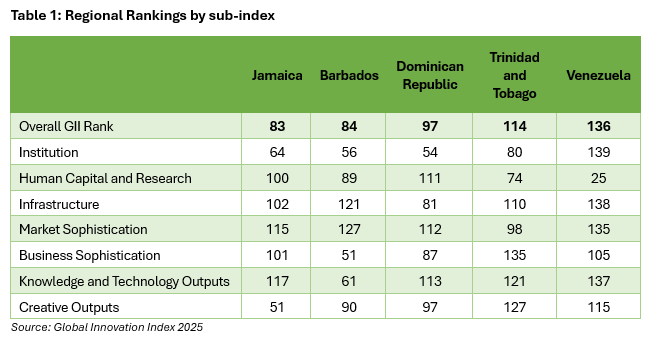
When looking at the sub-components that make up this index, T&T lags in four key areas when compared to regional peers:
- Infrastructure (rank 110) – Captures the Physical, and Digital infrastructure, as well as the energy environment of a country. It assesses the availability telecommunications and electricity networks, the accessibility of information and communication technologies (ICT), and the uptake of infrastructure that supports research, production and connectivity. T&T’s performance in this assessment is unremarkable, with relatively weak access to ICT at the public and governmental levels, and the lowest ecological sustainability; with the only strength being energy output per million people.
- Business Sophistication (rank 135) – Refers to the depth of the private sector to enable innovation through highly skilled employment, business expenditure on research and development, and linkages of the private sector with universities and other businesses to create new ideas and products. Despite having strengths in knowledge intensive employment, and females employed with advanced degrees, T&T fails to impress in other assessment categories, ranking last in knowledge absorption for businesses.
- Knowledge and Technology outputs (rank 121) – Measures how well a country turns innovation efforts into real, measurable results. It assesses the number of patents in a country, productivity growth, high tech exports, and scientific publications. T&T’s only strength highlighted in the category is software spending – making up 0.2% of GDP. All other categories highlight a distinct lack of international patents and low return from technology intensive industries.
- Creative Outputs (rank 127) – Focuses on the effect of innovation on creativity and culture by measuring how countries produce and export from the Orange Economy. Global trademarks, the size of the orange economy in trade, and online presence of source code, and mobile apps are considered. Despite having a rich and global recognized culture, T&T’s only highlighted strength is the value of creative economy exports as a percentage of total trade (0.3% of total trade).
Continued Private-Public efforts
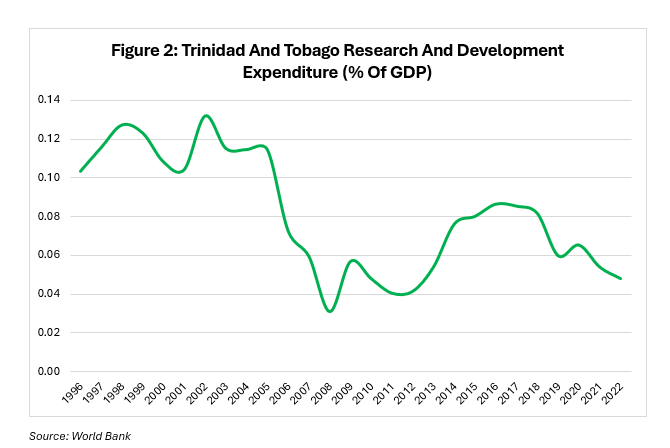
Efforts to improve T&T’s innovative culture are ongoing, with recent policies by government continuing to lay the necessary groundwork. From a policy perspective, the National Innovation Policy (2017) sits under the umbrella of “Vision 2030”, which aims to promote long-term, sustainable development while incorporating the United Nations Sustainable Development Goals. The National Innovation Policy sets ambitious goals for national innovation such as, establishing specialized centres to drive innovation in specific fields, enhancing the commercialization of innovative ideas, and achieving annual investment into R&D of 1% of GDP by 2025 (though this goal is far from being achieved, with the latest data form the World bank indicating just 0.05% of GDP spend on R&D).
In the budget presentation for FY2026, government unveiled the National Innovation and Incubator Programme, aimed at supporting the establishment of innovative businesses by 100 young graduates and entrepreneurs. This programme is just one of many which have been announced in recent years to promote innovation.
The private sector continues to be an active driver of innovation in Trinidad and Tobago, with major energy companies partnering with UWI, and UTT to fund research in renewable energy and carbon capture technologies, the CARIRI Centre for Enterprise Development and the Entrepreneurship Policy Programme nurturing start-ups in ICT and creative industries through mentorship and funding.
First Citizens has also invested heavily into promoting innovation within the organization and the public. Most recently, First Citizens sponsored the National Secondary Schools Entrepreneurship Competition (NSSEC) in 2025, which sees students channelling their innovative mindset to create a business and formulate solutions to obstacles presented by the competition.
Conclusion
Over the years, there has been ample evidence of innovation incentivizing economic growth and the current Nobel Prize in economics for 2025 solidifies this ongoing process. Ongoing, and future private-public efforts aimed at promoting innovation remain key to turning around the innovation metrics for T&T, however, the symptoms of the Dutch Disease remain a hinderance to achieving the growth benefits of innovation as described by the Nobel Prize economists. While the National Innovation Policy (2017) provides a framework, a push towards achieving the goals outlined, simultaneously targeting areas of weakness highlighted by the GII 2025 may hold the key to achieving sustainable growth that has been elusive for some time now in T&T.
DISCLAIMER
First Citizens Bank Limited (hereinafter “the Bank”) has prepared this report which is provided for informational purposes only and without any obligation, whether contractual or otherwise. The content of the report is subject to change without any prior notice. All opinions and estimates in the report constitute the author’s own judgment as at the date of the report. All information contained in the report that has been obtained or arrived at from sources which the Bank believes to be reliable in good faith but the Bank disclaims any warranty, express or implied, as to the accuracy, timeliness, completeness of the information given or the assessments made in the report and opinions expressed in the report may change without notice. The Bank disclaims any and all warranties, express or implied, including without limitation warranties of satisfactory quality and fitness for a particular purpose with respect to the information contained in the report. This report does not constitute nor is it intended as a solicitation, an offer, a recommendation to buy, hold, or sell any securities, products, service, investment or a recommendation to participate in any particular trading scheme discussed herein. The securities discussed in this report may not be suitable to all investors, therefore Investors wishing to purchase any of the securities mentioned should consult an investment adviser. The information in this report is not intended, in part or in whole, as financial advice. The information in this report shall not be used as part of any prospectus, offering memorandum or other disclosure ascribable to any issuer of securities. The use of the information in this report for the purpose of or with the effect of incorporating any such information into any disclosure intended for any investor or potential investor is not authorized.
DISCLOSURE
We, First Citizens Bank Limited hereby state that (1) the views expressed in this Research report reflect our personal view about any or all of the subject securities or issuers referred to in this Research report, (2) we are a beneficial owner of securities of the issuer (3) no part of our compensation was, is or will be directly or indirectly related to the specific recommendations or views expressed in this Research report (4) we have acted as underwriter in the distribution of securities referred to in this Research report in the three years immediately preceding and (5) we do have a direct or indirect financial or other interest in the subject securities or issuers referred to in this Research report.