Two Paths to Growth – Building Value from Within or through Acquisition
Insights

Growth is one of the clearest signs of a company’s ambition and long-term health. When a business increases sales, attracts new customers, enters new markets, or develops new products, it can strengthen its competitive position, create jobs, and increase shareholder value. But behind those impressive numbers is a question investor should always ask: where is this growth coming from? A company can grow organically by expanding what it already does, selling more products, raising prices, opening new locations or developing new offerings. It can also grow inorganically by acquiring other businesses, technologies, customers or capabilities.
Both approaches may produce the same result on paper: a larger company with higher revenue. However, the path taken to get there can tell a very different story about the company’s financial health and future. Organic growth tends to be slower but allows for more management control and reflects genuine, sustainable demand. Inorganic growth can accelerate expansion dramatically, though the speed comes with real risk: acquisitions create value when well executed, but destroy it when a company overpays, overleverages, or fails to properly integrate. For investors, growth should never be viewed simply as a bigger number on a financial statement, the more important question is whether that growth is creating lasting value or merely the appearance of it.
Why Growth Matters
At its core, growth is essential to a company’s long-term survival and success. Businesses operate in an environment that is constantly evolving, shaped by competitive pressures, technological advances, changing consumer preferences and shifting economic conditions. Companies that fail to adapt risk losing market share, weakening their competitive position or, over time, becoming obsolete.
Growth provides a pathway for companies to respond to these challenges. It allows businesses to increase revenue and profitability, expand their customer base, enter new markets, invest in innovation and strengthen their competitive position. As companies expand, they may also benefit from economies of scale, lowering costs and improving operating efficiency.
However, growth alone is not enough; it must also be sustainable. Sustainable growth occurs when a company can expand its revenue, earnings and operations at a pace that can be maintained over the long term without placing excessive strain on its financial or operational resources. Ideally, expansion should be supported by healthy profitability, strong cash flows, manageable debt and sufficient operational capacity. Rapid growth may appear attractive, but if it depends heavily on borrowing, persistent cash outflows or resources beyond what the business can reasonably support, it can ultimately weaken rather than strengthen the company.
Organic Growth
Companies may pursue growth organically by increasing sales, launching new products, expanding production capacity or entering new markets using their existing operations. Instead of buying another business, finding ways to sell more to existing customers, attract new ones, raise prices, introduce new products, expand into new markets is an option.
That is the essence of organic growth: a company turning its own strengths into something bigger. Over time, this type of expansion reveals whether a business truly understands its customers and has an offering people are willing to pay for. It also gives management greater control over the pace and direction of expansion, while allowing the company to preserve its culture. Financially, it provides valuable flexibility: strong operating cash flow, that can be reinvested into R&D, technology, or new markets while limiting reliance on additional borrowing. That said, organic expansion may still require external financing when the scale or timing of investment exceeds internally generated funds.
This appeal does not mean organic growth is always the easiest or fastest path forward. Building something from the ground up takes time, and the investment often comes long before the results. A company may spend years developing a product, or entering a new market, only to find that a competitor has moved faster. As industries mature, avenues for organic growth tend to narrow, and frequently will depend on the company’s ability to successfully navigate new and unfamiliar opportunities.
Beyond Organic Growth
While organic growth can provide a solid foundation for long-term expansion, it often takes time. Developing new products, building customer relationships, establishing distribution networks and gaining market share can take years.
For companies seeking to grow more quickly, there is another option: buy the growth rather than build it from the ground up. This is where mergers and acquisitions (M&A) enter the picture. Through acquisition, a company can gain immediate access to an established customer base, new products and services, technology, skilled employees, distribution networks or new geographic markets. In some cases, an acquisition can achieve in months what organic expansion might otherwise take years to accomplish.
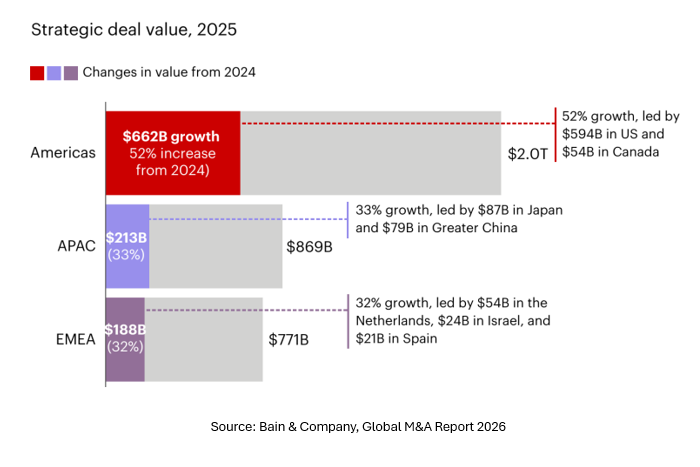
After two years of subdued activity, companies have increasingly returned to M&A as a tool for strategic growth. According to Bain & Company’s Global M&A Report 2026, global deal value increased by approximately 40% in 2025 to an estimated USD4.9 trillion, the second-highest annual total on record. The recovery was driven disproportionately by megadeals valued above USD5 billion and were broad-based, with deal activity recording double-digit growth across regions and industries.
Several factors contributed to this resurgence. The rapid advancement of artificial intelligence, shifting global trade policies and modest economic growth have encouraged companies to reassess their competitive positions. Against this changing landscape, acquisitions can provide a faster route to gaining scale, acquiring new capabilities and positioning a business for future growth.
The appetite for large transactions remained strong in 2026. According to Bain & Company’s newly released 2026 M&A Midyear Report, global deal value surged 41% year over year to USD2.4 trillion during the first five months of 2026. At this pace, full-year deal value is projected to exceed USD5.3 trillion, approaching the record USD5.6 trillion set in 2020 and building on an already strong 2025, which recorded the second-highest annual deal value on record.
Figure 1: Trend in M&A
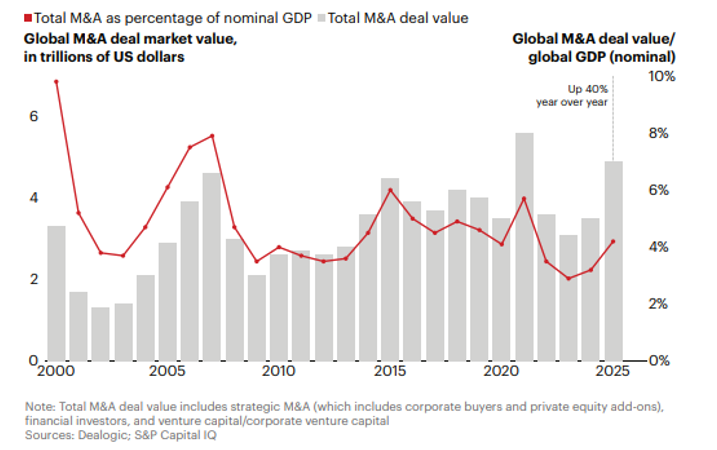
The continued strength in M&A reflects companies’ efforts to build scale, strengthen resilience and remain competitive in a rapidly changing business environment. The growing influence of artificial intelligence, slower economic growth, persistent inflation and heightened geopolitical uncertainty is reshaping industries and business models. Against this backdrop, companies are increasingly turning to acquisitions as a faster route to expand capabilities, strengthen market positions and position themselves for future growth.
Source: Bain & Company, Global M&A Report 2026
Figure 2: M&A Deal Market Value (USD trillions)
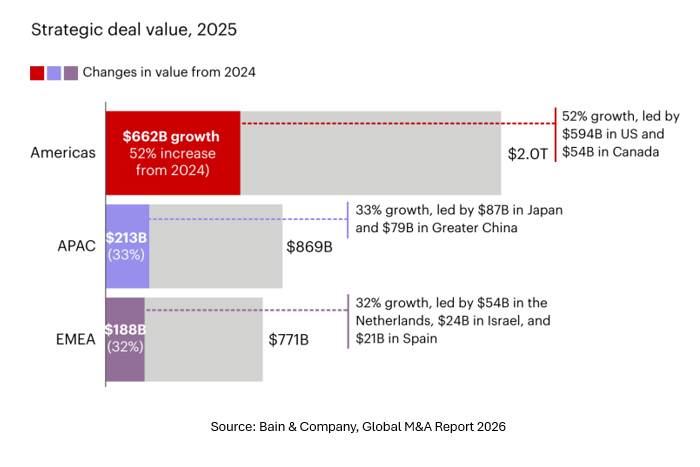
Figure 3: M&A Deal Market Value by Geographic Region (USD trillions)
When Growth Drives Strategy, Where Should Investors Focus?
For investors, headline growth is only the starting point. The more important consideration is what drives this growth, how it is being achieved and, ultimately, whether it can be sustained.
The first consideration is the quality and sustainability of growth. Investors should determine whether a company is attracting and retaining customers, strengthening its competitive position and expanding through advantages that can support future growth. By contrast, rapid expansion driven primarily by a one-off acquisition, temporary surge in demand or other short-term factors may be difficult to sustain.
Profitability is equally important. Revenue growth is far more valuable when accompanied by sustained or improving profit margins. A company may increase sales by 20%, but if margins are declining, it could indicate that substantial costs are being incurred to generate that growth. Conversely, a company growing at a more moderate pace while expanding its margins may be demonstrating stronger pricing power, greater operating efficiency or better cost management.
Investors should also pay close attention to cash flow. Reported earnings can be affected by accounting and non-cash items, while cash flow provides a clearer indication of whether the underlying business is generating sufficient resources to support its expansion. Strong and consistent cash generation gives a company greater flexibility to reinvest in the business, pursue new opportunities, service debt and return capital to shareholders.
Ultimately, however, growth should create value, not simply make a company larger. This is where return on invested capital becomes particularly important. A company can expand rapidly while destroying shareholder value if it continually invests capital in projects or acquisitions that generate inadequate returns. Ideally, the returns generated from these investments should exceed the company’s cost of capital. Otherwise, growth can become an expensive exercise in becoming bigger without becoming better.
What Does This Mean for Investors, and Where Are the Opportunities?
At its heart, the difference between organic and inorganic growth comes down to one simple choice: build or buy. Organic growth asks a company to develop its own strengths, winning customers, creating products, improving operations, and expanding into new markets one step at a time. Inorganic growth takes a faster route, using acquisitions, mergers, or partnerships to gain scale, technology, talent, or market access that might otherwise take years to develop. Neither approach is inherently better.
The right choice depends on the company’s circumstances, the opportunity in front of it, and whether the investment can generate an attractive return. As economic conditions change, so does the balance between the two. Higher borrowing costs can make debt-funded acquisitions less appealing, while strong cash-generating businesses may find organic investment more attractive. Acquisitions will remain an important strategic tool, particularly in industries where technology and speed determine who leads the next wave of growth.
For investors, the story should never end with how quickly a company is expanding. The more important question is whether that expansion is making the business stronger. Growth only creates lasting value when it translates into stronger earnings, healthy cash flow, attractive returns on invested capital, and a balance sheet capable of supporting the journey ahead. The companies that stand out over time are not necessarily the ones that grow the fastest, but those that know when to build, when to buy, and when to walk away. In the end, revenue tells us that a company is getting bigger; the quality of its profits, cash generation, and returns tell us whether it is getting better. That distinction is what separates growth that simply looks impressive from growth that genuinely creates lasting value.
DISCLAIMER
This report has been prepared by First Citizens Investment Services Limited, a subsidiary of First Citizens Bank Limited. It is provided for informational purposes only and without any obligation, whether contractual or otherwise. All information contained herein has been obtained from sources that First Citizens Investment Services believes to be accurate and reliable. All opinions and estimates constitute the author’s judgment as at the date of the report. First Citizens Investment Services does not warrant the accuracy, timeliness, completeness of the information given or the assessments made. Opinions expressed may change without notice. This report does not constitute an offer or solicitation to buy or sell any securities discussed herein. The securities discussed in this report may not be suitable to all investors, therefore Investors wishing to purchase any of the securities mentioned should consult an investment adviser.
DISCLOSURE
We, First Citizens Investment Services Limited hereby state that (1) the views expressed in this Research report reflects our personal view about any or all of the subject securities or issuers referred to in this Research report, (2) we are a beneficial owner of securities of the issuer (3) no part of our compensation was, is or will be directly or indirectly related to the specific recommendations or views expressed in this Research report (4) we have acted as underwriter in the distribution of securities referred to in this Research report in the three years immediately preceding and (5) we do have a direct or indirect financial or other interest in the subject securities or issuers referred to in this Research report.