Inflation and You
Insights
We have all quietly observed the prices of everyday items going up. The groceries our parents once bought for $100 look very different from what we can buy today with $100. Even compared to last year, many everyday items have become more expensive or unaffordable in some instances, forcing households to change consumption patterns. This steady rise in prices is known as inflation; a phenomenon which affects everyone in one way or another.
From a macroeconomic perspective, inflation has brought significant instability around the world, bringing many economies to their knees as prices spiral out of control. Recent examples of this lie in Argentina, Suriname, and Venezuela, all of which experienced triple-digit inflation in a short space of time. From an individual perspective, it is important to understand what inflation is, how it affects the economy/policy, why reported inflation figures sometimes feel far from reality, and most importantly, how it affects the individual.
What is inflation?
Inflation is defined by the International Monetary Fund (IMF) as the rate of increase in prices over a period of time. Inflation is usually measured using the Consumer Price Index (CPI), a basket of goods and services which is representative of consumer spending. The inflation rate is the percentage change in the CPI value from one period to another.
Weights of items in the Trinidad and Tobago’s (T&T) CPI
The Central Statistical Office (CSO) gathers the relevant data required to generate the CPI and different sub-indices for T&T; with product/service categories having varying impacts on the overall inflation figures. The weighting of each item in the T&T CPI is shown in Table 1 below:
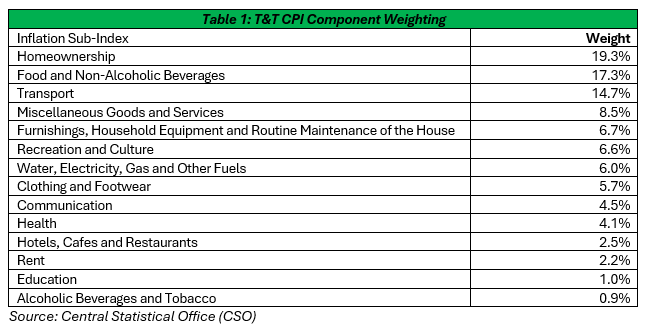
The weights of each sub-index will determine how increases in each category impact the overall inflation figure. Using Alcoholic Beverages and Tobacco as an example, the recent increase in excise duties has resulted in a sharp rise in price in this category, registering an increase of 23.6% for December 2025 (year on year). Alcoholic Beverages and Tobacco represents 0.9% of the overall CPI and contributed to a 0.002% increase in the overall inflation figure during that month.
Key Inflation Concepts
Core inflation: this measures the change in the less volatile items in the CPI to better gauge how prices have evolved in an economy and is a useful tool to measure underlying inflationary pressures. In Trinidad and Tobago, core inflation excludes the food sub-category as food prices tend to vary significantly. In the United States, core CPI excludes food and energy prices, as these are the most volatile categories.
Shrinkflation: this term is relatively recent but has become increasingly relevant, especially since the COVID-19 pandemic. It is a situation when the price of a product remains the same, but the size of the product shrinks. Companies do this either to boost product margins, or to cover up the impact of rising costs.
Stagflation: this occurs when an economy is experiencing several key economic problems simultaneously. The name is derived from a combination of “stagnation” and “inflation.” Stagflation exists when an economy records negative or no GDP growth, high unemployment levels, and high inflation (typically above government targets). Combatting stagflation through policy is particularly complicated since there is no simple policy to remedy it; traditional anti-inflationary policies tend to be ineffective at combatting stagflation, since it generally occurs when there are long-term structural inefficiencies in an economy.
Imported inflation: this applies to countries that have a significant import bill relative. Imported inflation is especially relevant to Caribbean countries as the majority of goods available are imported. Imported inflation is when the cost of imported goods or services increase – this can most frequently be due to fluctuations in the exchange rate or external shocks which cause global inflationary conditions.
Disinflation: refers to a period in time when the rate of inflation in an economy is slowing down. Disinflation does not mean that prices in an economy are declining, rather the rate at which prices are increasing is lower. Prices only fall in an economy when deflation occurs. Deflation is when a rate of inflation is below 0%, in the negative range.
Hyperinflation: this is the most extreme example of inflation. It is typically caused by excessive currency printing by a monetary authority, or excessive demand. Hyperinflationary conditions have far reaching implications ranging from a complete economic collapse to widespread social and political unrest. In many instances, significant structural adjustments are necessary recover from a hyperinflationary environment.
How Inflation Affects Policy
Central banks often pay attention to inflation (and other key economic data) in determining monetary policy stance. A central bank would use the tools at their disposal – manipulating their policy interest rate and adjusting the available money supply to guide the direction of inflation. In times when inflation is high, a central bank would increase their policy interest rate to slow down consumption in the economy, slowing the rate of inflation; and in times when inflation is below target, a central bank can choose to cut their interest rate, though other economic factors are considered.
The figures hide a larger problem – Cumulative inflation
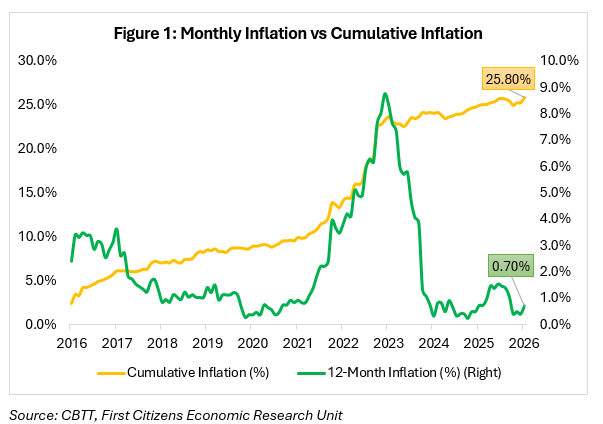
Trinidad and Tobago boasts one of the lowest inflation rates in the region, at just 0.7% (year on year) in January 2026. On the surface, this would mean that prices increased by just 0.7% when compared to January 2025 levels, however, the harmful effect of inflation is better represented when we look at how prices have changed cumulatively over a longer period of time. The cumulative change in prices from the start of the CPI base year (January 2015) to January 2026 was 25.8%, significantly higher than the January 2026 year on year data. Figure 1 below shows how cumulative inflation and monthly inflation in the T&T economy have evolved since 2015.
Figure 1 also visualizes the key difference with disinflation and the cumulative inflation figures. Cumulative inflation captures the compounding effect on prices even when a disinflationary period.
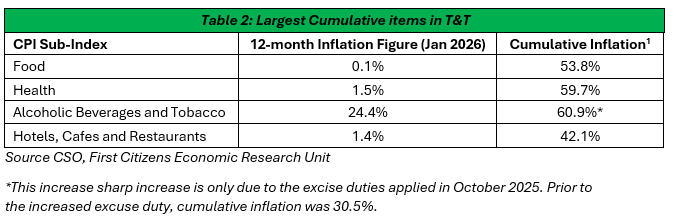
The issue is more pronounced when we look at the sub-categories of inflation. In some instances, the sub-category cumulative inflation far surpasses that of the overall CPI. The categories with the highest level of inflation since 2015 were:
Conclusion
Regardless of the specific type, inflation is an issue that affects everyone in an economy, from governments and central banks to individuals. On an individual level, the erosion of spending power does not stop at the headline level, it is compounded with each successive month of inflation. While headline inflation figures may boast a small increase in prices, the reality at the individual level is that what we feel in our day-to-day lives is revealed in cumulative inflation that constantly increases in the absence of deflation. While uncomfortable to come to terms with, inflation is an unavoidable reality of any economy that requires a balancing act from both households and policymakers to navigate.
DISCLAIMER
First Citizens Bank Limited (hereinafter “the Bank”) has prepared this report which is provided for informational purposes only and without any obligation, whether contractual or otherwise. The content of the report is subject to change without any prior notice. All opinions and estimates in the report constitute the author’s own judgment as at the date of the report. All information contained in the report that has been obtained or arrived at from sources which the Bank believes to be reliable in good faith but the Bank disclaims any warranty, express or implied, as to the accuracy, timeliness, completeness of the information given or the assessments made in the report and opinions expressed in the report may change without notice. The Bank disclaims any and all warranties, express or implied, including without limitation warranties of satisfactory quality and fitness for a particular purpose with respect to the information contained in the report. This report does not constitute nor is it intended as a solicitation, an offer, a recommendation to buy, hold, or sell any securities, products, service, investment, or a recommendation to participate in any particular trading scheme discussed herein. The securities discussed in this report may not be suitable to all investors, therefore Investors wishing to purchase any of the securities mentioned should consult an investment adviser. The information in this report is not intended, in part or in whole, as financial advice. The information in this report shall not be used as part of any prospectus, offering memorandum or other disclosure ascribable to any issuer of securities. The use of the information in this report for the purpose of or with the effect of incorporating any such information into any disclosure intended for any investor or potential investor is not authorized.
DISCLOSURE
We, First Citizens Bank Limited hereby state that (1) the views expressed in this Research report reflect our personal view about any or all of the subject securities or issuers referred to in this Research report, (2) we are a beneficial owner of securities of the issuer (3) no part of our compensation was, is or will be directly or indirectly related to the specific recommendations or views expressed in this Research report (4) we have acted as underwriter in the distribution of securities referred to in this Research report in the three years immediately preceding and (5) we do have a direct or indirect financial or other interest in the subject securities or issuers referred to in this Research report.